

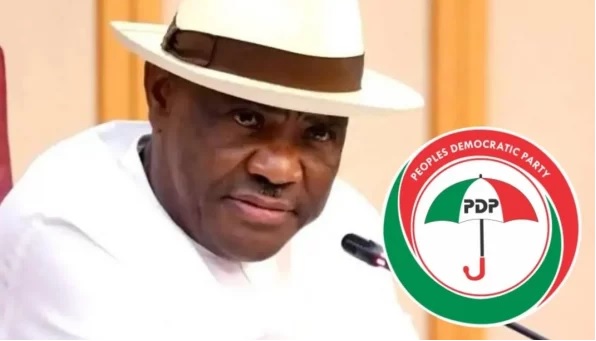
A faction of the Peoples Democratic Party (PDP) aligned with the Minister of the Federal Capital Territory, Nyesom Wike, has set the cost of its presidential Expression of Interest and Nomination forms at a staggering ₦51 million ahead of the 2027 general elections.
The decision, which is already stirring debate within political circles, underscores the intensifying power struggle within the PDP as rival blocs position themselves for control of the party’s future. The faction’s move signals an early start to the 2027 race and reflects the growing significance of internal party structures in shaping Nigeria’s electoral landscape.
According to sources familiar with the development, the ₦51 million fee covers both the Expression of Interest and Nomination forms required for aspirants seeking to contest under the faction’s platform. While high nomination fees are not new in Nigerian politics, the amount has raised questions about inclusivity and the accessibility of the political process.
Supporters of the decision argue that such fees help ensure that only serious and financially capable candidates enter the race, thereby reducing frivolous aspirants. They also note that major political parties in Nigeria have historically set high nomination costs, particularly for presidential contests.
However, critics see the move as further evidence of the monetization of politics, warning that it could exclude younger candidates and those without deep financial backing. Analysts argue that high fees often reinforce elite dominance within parties, limiting opportunities for broader participation and innovation in leadership.
The development comes amid ongoing internal divisions within the PDP, with multiple factions laying claim to legitimacy and influence. The bloc associated with Wike has been particularly prominent in recent political maneuverings, leveraging its strategic position within government and party structures.
Observers note that the fragmentation within the PDP could have significant implications for its performance in the 2027 elections. Once Nigeria’s dominant political force, the party has struggled in recent years with internal conflicts, defections, and leadership disputes, all of which have weakened its cohesion.
The introduction of a ₦51 million nomination fee by one faction may further deepen these divisions, especially if other groups within the party adopt different approaches. Questions also remain about how the Independent National Electoral Commission (INEC) will interpret and respond to competing claims within the party when the electoral process formally begins.
Beyond the PDP, the development reflects a broader trend in Nigerian politics, where early alignments and strategic positioning are becoming increasingly decisive. With other parties such as the African Democratic Congress (ADC) and the ruling All Progressives Congress (APC) also witnessing internal realignments, the political terrain ahead of 2027 is rapidly evolving.
Public reaction has been mixed, with some Nigerians expressing concern over the growing cost of political participation. Civil society groups have called for reforms to reduce financial barriers and promote a more inclusive democratic process.
As the countdown to 2027 continues, the PDP’s internal dynamics—and decisions such as this—will play a crucial role in determining its ability to mount a credible challenge on the national stage. For now, the ₦51 million price tag stands as both a symbol of ambition and a point of contention in Nigeria’s unfolding political drama.


