

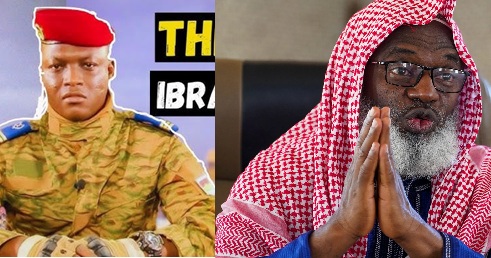
Islamic scholar Dr. Ahmad Abubakar Mahmud Gumi has criticized Burkina Faso’s transitional leader, Captain Ibrahim Traoré, over his recent comments opposing the expansion of Sharia law, warning that such a stance could inadvertently strengthen extremist recruitment.
In a statement, Gumi argued that Traoré, who assumed power following a military coup in 2022, lacks sufficient political experience to fully appreciate the complex social, religious and geopolitical dynamics shaping Burkina Faso and the wider Sahel region.
The cleric described the 38-year-old military leader as relying primarily on his military background and contended that confronting religious extremism requires a more nuanced understanding of the societies affected by insurgency.
According to Gumi, policies perceived as targeting Islamic institutions or scholars risk providing extremist groups with propaganda that could be used to recruit more fighters against the country’s secular government.
He cautioned that sustainable counterterrorism efforts should combine military operations with dialogue, community engagement, good governance and policies that address the underlying drivers of radicalization.
Gumi’s comments followed reports that Traoré had questioned the value of sending large numbers of Burkinabè students abroad solely for Islamic studies while emphasizing greater investment in practical disciplines such as engineering, science and technology. He also reportedly reaffirmed Burkina Faso’s status as a secular state and warned against extremist ideologies.
Traoré has consistently presented his administration as committed to restoring security and national sovereignty while combating armed groups linked to al-Qaeda and the Islamic State, which have carried out deadly attacks across Burkina Faso since 2015.
Supporters of the transitional government argue that stronger action against extremist networks is necessary to protect civilians and preserve national unity. They maintain that promoting technical education alongside efforts to counter violent extremism is part of a broader strategy to strengthen national development.
Others, however, have cautioned that policies touching on religion should be carefully communicated to avoid alienating peaceful religious communities whose cooperation is essential in countering violent extremism.
Security analysts note that successful counterinsurgency campaigns typically combine military pressure with intelligence gathering, economic development, respect for human rights and partnerships with local communities to reduce extremist influence.
Burkina Faso remains one of the countries most affected by insecurity in the Sahel, with persistent attacks by armed groups causing thousands of deaths and displacing millions of people in recent years.
Observers say the differing views expressed by Traoré and Gumi reflect broader debates across the region on how governments should balance secular governance, religious freedom and effective strategies for addressing violent extremism.
As Burkina Faso continues its efforts to restore stability, analysts emphasize that long-term peace will depend not only on military operations but also on inclusive governance, economic opportunity and sustained community engagement to counter radicalization.


