

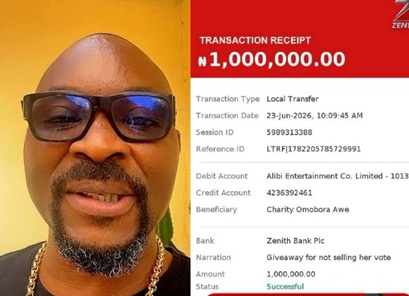
A Nigerian woman, identified as Awe, has gained national attention after rejecting an alleged ₦15,000 offer to sell her vote during the June 20 governorship election in Ikere-Ekiti, Ekiti State.
In a viral video recorded after the election, Awe publicly condemned vote-buying and revealed that she refused the money despite economic hardship, insisting that her vote represented her conscience and the future of her community.
Her action drew widespread praise from Nigerians who described her as an example of civic responsibility and resistance against electoral corruption.
In recognition of her stance, businessman and public commentator Isaac Fayose announced a ₦1 million bank transfer to Awe, describing the donation as a personal reward for her honesty and commitment to democratic values.
Another supporter identified as Bishop also contributed an additional ₦500,000, bringing the total reward she received to ₦1.5 million.
The incident occurred during the governorship election that returned Governor Biodun Oyebanji for a second term after securing a decisive victory with 319,224 votes.
However, the election was also accompanied by renewed concerns over voter inducement. Election observers and civil society organisations, including Yiaga Africa, have repeatedly warned that vote-buying remains a significant threat to Nigeria’s democratic process.
Vote trading has become one of the major challenges confronting elections in Nigeria, where political actors are often accused of influencing voters with cash, food, or other material benefits in exchange for electoral support.
Democracy advocates argue that rejecting such inducements strengthens electoral integrity and encourages leaders to emerge based on policies, competence, and genuine public support rather than financial influence.
Awe’s decision has sparked broader conversations across social media about the power of individual choices in protecting democracy, with many Nigerians calling for stronger enforcement of electoral laws against those who attempt to buy votes.
The episode highlights the ongoing struggle between entrenched practices of voter inducement and growing public demands for free, fair, and credible elections in Nigeria.


