

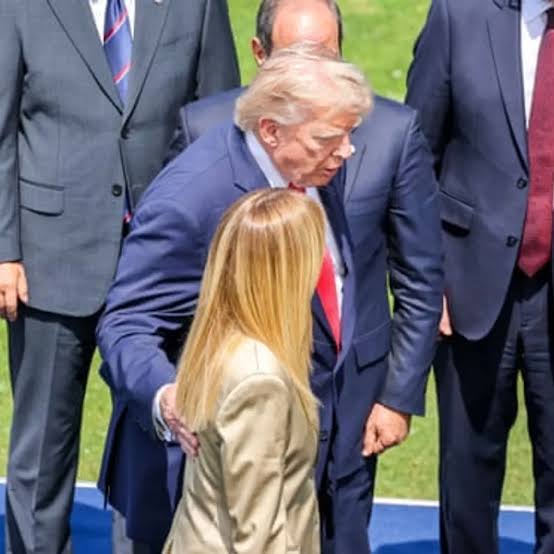
Italian Prime Minister Giorgia Meloni has publicly dismissed claims made by former United States President Donald Trump regarding a photograph taken during the recent G7 Summit, insisting that she never requested a special photo opportunity with the American political figure.
The exchange has attracted international attention, adding another chapter to the often colorful interactions involving world leaders and high-profile political personalities. The controversy emerged after comments attributed to Trump suggested that Meloni had specifically sought a photograph with him during the gathering of leaders from some of the world’s largest economies.
However, the Italian leader moved quickly to set the record straight, rejecting the assertion and emphasizing that the encounter occurred within the normal activities and protocols associated with the summit.
Speaking through official channels and media reports, Meloni denied personally requesting a photograph with Trump, describing suggestions to the contrary as inaccurate. The clarification was aimed at addressing growing media speculation surrounding the interaction and preventing misinformation from overshadowing discussions held during the international summit.
The G7 Summit, which brought together leaders from major industrialized nations, focused on a range of critical global issues, including economic cooperation, international security, trade, energy policy, migration, and geopolitical challenges. As is common at such events, photographs featuring political leaders often attract significant public attention and media coverage.
Political analysts note that images captured during international summits frequently become symbols of diplomatic relationships, alliances, or political messaging. As a result, even seemingly minor interactions between leaders can generate widespread debate and interpretation.
The controversy surrounding the Meloni-Trump photograph quickly gained traction on social media, where supporters and critics of both figures offered competing narratives about what occurred. Some commentators viewed the situation as a misunderstanding amplified by online discussions, while others saw it as part of broader efforts to shape public perceptions of international political relationships.
Meloni, who has emerged as one of Europe’s most influential conservative leaders, has maintained a prominent role in discussions surrounding European Union policy, migration, defense cooperation, and economic growth. Since taking office, she has worked to strengthen Italy’s position within Europe while also cultivating relationships with international partners.
Trump, meanwhile, remains one of the most recognizable political figures globally. Despite no longer serving as U.S. president, his comments continue to attract extensive media coverage and often generate reactions from political leaders around the world.
Observers note that interactions involving Trump frequently become headline news due to his significant influence on both American and international politics. His statements regarding foreign leaders and global events are regularly scrutinized by political analysts and news organizations.
The latest dispute highlights the growing role of social media and instant communication in modern diplomacy. In previous decades, misunderstandings involving political figures may have remained confined to diplomatic circles. Today, however, such exchanges can become global news within minutes.
Experts in international relations argue that maintaining clarity in public communications has become increasingly important for governments seeking to avoid unnecessary diplomatic distractions. They note that summit meetings are primarily intended to address substantive policy issues rather than personal controversies.
Despite the attention generated by the photograph debate, officials involved in the summit have continued to emphasize the importance of the discussions that took place during the gathering. Leaders focused on strengthening cooperation on economic stability, international security, climate initiatives, and emerging global challenges.
Political commentators suggest that the controversy is unlikely to have any significant impact on relations between Italy and the United States. Instead, it is being viewed largely as a media-driven episode that reflects the intense scrutiny faced by high-profile leaders.
For Meloni, the swift response demonstrates a determination to control the narrative surrounding her international engagements and avoid distractions from policy priorities. By publicly denying Trump’s claim, she sought to reinforce her position and clarify the circumstances of the widely discussed interaction.
As global audiences continue to follow developments involving influential political figures, the incident serves as a reminder of how quickly diplomatic moments can become major news stories in the digital age.


