

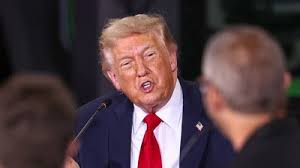
Former US President Donald Trump ended an NBC ‘Meet the Press’ interview early after a heated argument over California’s vote-counting process, sparking debate over election integrity claims.
Former United States President Donald Trump abruptly ended a televised NBC interview after a heated exchange with journalist Kristen Welker over California’s vote-counting process, turning what was meant to be a wide-ranging political discussion into a moment of controversy.
The interview, part of NBC’s “Meet the Press” series, was recorded on Friday at a Wisconsin farm setting featuring hay bales and a John Deere tractor. It initially covered a range of national issues including US strikes on Iran-linked targets, recent jobs data, and broader questions about election integrity in the United States.
However, tensions escalated when the discussion shifted to California’s June 2 primary election and the time taken to complete vote counting. Trump questioned the delay in final results, describing the process as suspicious and suggesting without evidence that the system was compromised.
California election officials have consistently explained that the state’s vote-counting procedures include standard verification processes such as signature checks and mail-in ballot validation. Officials also noted that the reporting deadline extends to June 15, making delays in final results a routine part of the process rather than an indication of irregularities.
Despite these explanations, Trump strongly criticized the system during the interview, insisting that the slow pace of counting undermines public confidence in elections. He argued that delays in reporting results create opportunities for manipulation, a claim frequently raised by him in past electoral discussions.
The exchange became increasingly tense as Welker challenged the former president’s assertions, pointing out that California’s procedures are consistent with established election laws and that no evidence of fraud had been confirmed by county authorities.
At one point during the interview, Trump reacted sharply, accusing the media of bias and questioning the credibility of the discussion. He reportedly said, “They’re crooked. Just like you’re crooked,” before deciding to end the interview early after approximately 50 minutes of conversation.
The sudden conclusion of the sit-down sparked immediate reactions across political and media circles, with viewers divided over the former president’s conduct.
Supporters praised Trump for what they described as standing up to what they see as biased media questioning, arguing that he continues to challenge mainstream narratives about election processes and media reporting.
Critics, however, described the incident as an emotional outburst, arguing that walking out of interviews undermines constructive political dialogue and raises concerns about how leaders engage with the press.
The controversy comes amid ongoing national debates in the United States over election security, mail-in voting, and the integrity of vote-counting systems. These issues have remained highly sensitive since the 2020 presidential election and continue to influence political discourse.
Election officials in California reiterated that the state’s vote-counting timeline is consistent with legal requirements and is designed to ensure accuracy and transparency. They emphasized that mail-in ballots require additional verification steps, which naturally extend the counting process beyond election day.
Political analysts note that disagreements over election procedures have become a recurring theme in American politics, often intensifying during election cycles and high-profile interviews involving major political figures.
The Wisconsin setting of the interview added a symbolic backdrop to the exchange, with rural imagery contrasting with the heated political discussion taking place between Trump and Welker.
NBC has not issued an official statement regarding the early conclusion of the interview, though the footage has already circulated widely across news platforms and social media, generating extensive commentary and debate.
As reactions continue, the incident highlights the ongoing polarization surrounding election-related discussions in the United States. For supporters and critics alike, the interview has further fueled debate about media relations, political accountability, and the credibility of electoral processes.
Whether viewed as a justified objection or an overreaction, Trump’s decision to end the interview has once again placed him at the center of national attention, reinforcing his continued influence on American political discourse.


