

Introduction
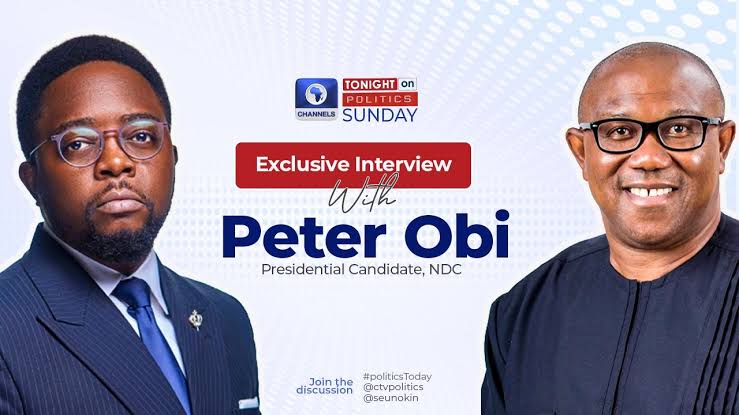
NDC presidential candidate Peter Obi appeared on Channels Television’s Sunday Politics in a wide-ranging interview where he discussed Nigeria’s economy, governance, insecurity, corruption, national unity, and his vision for the country ahead of the 2027 general election. Throughout the interview, Obi repeatedly argued that Nigeria’s problems stem from poor leadership rather than a lack of human or natural resources.
The interview was structured around key national issues, with Obi consistently returning to his central belief that governance failures, rather than structural limitations, are responsible for Nigeria’s current challenges. He positioned his remarks within a broader call for reform, accountability, and a shift toward productive economic management.
1. Why He Wants to Become President
Obi insisted that his presidential ambition is not driven by personal ambition or the pursuit of power.
Key points
- He is motivated by a desire to rebuild Nigeria.
- Nigeria possesses enormous human and natural resources.
- Good governance is the missing ingredient.
- Leadership should be about service.
Quote
“I am not desperate to be President. I am desperate to see Nigeria work.”
2. Corruption and Leadership
Obi devoted considerable attention to corruption, arguing that Nigeria cannot develop while public officials enrich themselves at the expense of citizens.
He argued that:
- Corruption destroys public trust.
- Public funds belong to Nigerians.
- Leaders must lead by example.
- Integrity is essential for national development.
Quote
“You cannot inspire change while stealing public funds. That is not leadership; it is criminality.”
3. Nigeria’s Economy
According to Obi:
Nigeria has become a consumption economy instead of a production economy.
He said Nigeria imports virtually everything while exporting very little.
He maintained that:
- Nigeria must produce.
- Nigeria must export.
- Nigeria must industrialize.
- Nigeria must support manufacturers.
He proposed:
- Agricultural revolution.
- Industrial parks.
- Export promotion.
- Manufacturing incentives.
- SME financing.
4. Agriculture
Peter Obi described agriculture as Nigeria’s quickest route to economic prosperity.
He proposed:
- Mechanized farming.
- Food processing industries.
- Export-oriented agriculture.
- Youth participation in farming.
- Agricultural value chains.
He argued agriculture can create millions of jobs.
5. Youth Unemployment
Obi described unemployment as a national emergency.
His recommendations included:
- Technical education.
- Digital economy.
- Entrepreneurship.
- Innovation hubs.
- Skills acquisition.
He said young Nigerians should become producers rather than depend solely on government employment.
6. Poverty
Peter Obi argued that poverty fuels insecurity.
According to him:
- Hungry people become vulnerable.
- Poverty increases crime.
- Poverty weakens national stability.
His solution:
- Job creation.
- Productive economy.
- Better education.
- Better healthcare.
7. Insecurity
Obi said insecurity cannot be solved solely through military operations.
He advocated:
- Intelligence-led policing.
- Better equipment.
- Better welfare.
- Community policing.
- Professional security agencies.
He argued that economic opportunities also reduce crime.
8. National Unity
Obi said Nigeria remains one country despite ethnic and religious differences.
He promised:
- Inclusive government.
- Equal treatment.
- Justice.
- Fair appointments.
- National reconciliation.
He stressed that unity must be built on fairness.
9. Governance
According to Obi:
Government should become smaller and more efficient.
He proposed:
- Reducing waste.
- Cutting unnecessary spending.
- Transparent budgeting.
- Accountability.
- Value for money.
10. Cost of Governance
Obi criticised extravagant government spending.
He suggested:
- Reducing luxury spending.
- Eliminating waste.
- Prioritising education.
- Prioritising healthcare.
- Prioritising infrastructure.
11. Education
Education remained central to Obi’s development philosophy.
He advocated:
- Better schools.
- Teacher training.
- Digital learning.
- Skills education.
- Increased funding.
12. Healthcare
Obi argued Nigeria spends too much money on medical tourism.
He proposed:
- Better hospitals.
- Better equipment.
- Better salaries for health workers.
- Primary healthcare expansion.
13. Electricity
Obi described electricity as the foundation of industrialisation.
He argued that:
- Manufacturers require stable power.
- Investors require reliable electricity.
- Economic growth depends on energy.
14. Infrastructure
He advocated:
- Better roads.
- Rail expansion.
- Modern ports.
- Efficient airports.
Infrastructure, he argued, should support productivity.
15. Foreign Investment
According to Obi:
Investors seek:
- Stability.
- Rule of law.
- Security.
- Policy consistency.
He argued Nigeria can attract substantial investment if these conditions are met.
16. Communication Between Government and Citizens
Obi said leaders should communicate regularly with citizens.
He maintained that Nigerians deserve explanations about government policies and decisions.
17. Criticism of Current Administration
Without focusing solely on personalities, Obi argued that:
- Nigerians are experiencing hardship.
- Inflation has worsened.
- Poverty has increased.
- Businesses are struggling.
- Citizens deserve better governance.
He urged leaders to focus on solving these problems.
18. Political Attacks
Obi dismissed personal attacks against him.
He argued:
Nigeria’s problems—not Peter Obi—should dominate public discussion.
19. Democracy
Obi reiterated support for:
- Credible elections.
- Independent institutions.
- Rule of law.
- Electoral transparency.
- Citizens’ participation.
20. Vision for Nigeria
Peter Obi concluded by presenting a vision centred on:
- Honest leadership.
- Fiscal discipline.
- Productive economy.
- National unity.
- Security.
- Education.
- Healthcare.
- Industrialisation.
- Agriculture.
- Youth empowerment.
- Accountability.
- Inclusive governance.
He expressed confidence that Nigeria can recover if leadership prioritises competence, integrity, and service over personal interest.
Overall Message
The interview consistently returned to one central argument: Nigeria’s challenges are not caused by a lack of resources but by failures in governance. Obi maintained that ethical leadership, prudent management of public resources, investment in productive sectors, and inclusive governance are essential to improving citizens’ welfare and restoring confidence in the country.


