
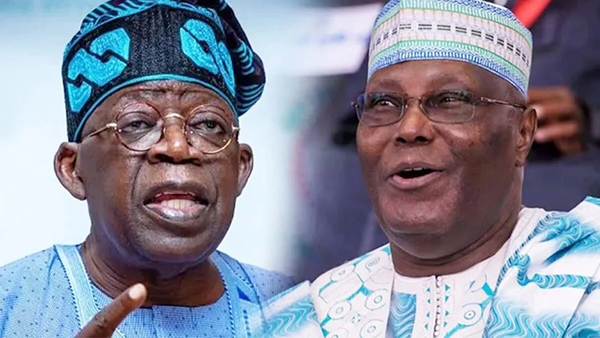
The Presidency has renewed its criticism of the presidential candidate of the African Democratic Congress, Atiku Abubakar, over his pledge to restore petrol subsidy if elected president in 2027, warning that the policy could cost Nigeria an estimated N19.1 trillion annually.
The figure was disclosed by Otega Ogra, Senior Special Assistant to President Bola Tinubu on Digital and New Media, amid an escalating political dispute over the future of petrol pricing and subsidy policy.
Atiku has repeatedly defended his proposal, insisting that he would restore what he describes as a targeted petrol subsidy if elected. He argues that the removal of the subsidy under the Tinubu administration has contributed to higher transportation and food costs and placed additional pressure on already struggling households.
The former vice-president has also argued that government has a responsibility to protect citizens from severe economic hardship and questioned how the revenues supposedly saved from subsidy removal have been utilised.
However, the Presidency has challenged Atiku to explain precisely how his proposed subsidy would be financed.
Ogra said the N19.1 trillion estimate was based on assumptions involving an international crude oil price of $80 per barrel and a subsidy requirement of approximately $40 per barrel. He further estimated that the proposed intervention could amount to about N52.3 billion daily or N1.5 trillion monthly.
The presidential aide questioned whether Atiku’s proposal contained sufficient details on the amount of crude required, the volume of petrol to be subsidised, the beneficiaries and any spending limit.
He argued that without such details, Nigerians could not properly assess the financial sustainability of the former vice-president’s proposal.
The Presidency’s criticism follows a series of differing explanations from members of Atiku’s campaign team concerning how long the proposed subsidy would remain in place.
Atiku’s spokesperson, Paul Ibe, initially indicated that an Atiku administration would restore the subsidy temporarily before eventually phasing it out. Another senior aide, Phrank Shaibu, subsequently rejected that characterisation, saying Atiku had not committed to a predetermined date for ending the subsidy.
Atiku later intervened personally, insisting that his position had not changed and reaffirming his commitment to restoring a targeted subsidy.
The Presidency has seized on the conflicting explanations to accuse Atiku’s camp of lacking clarity on a policy that could have major consequences for Nigeria’s finances.
The debate is particularly significant because petrol subsidy has historically imposed a substantial burden on the federal budget. President Tinubu announced the removal of the subsidy in May 2023, describing the policy as financially unsustainable.
The reform immediately resulted in a substantial increase in petrol prices and contributed to higher transportation and living costs. The government, however, has maintained that subsidy removal was necessary to free resources for development and reduce pressure on public finances.
Atiku has taken a different position, arguing that subsidy removal would have been more defensible if the savings had been transparently channelled into areas such as education, healthcare, infrastructure, security and poverty reduction.
The former vice-president has therefore linked his proposed subsidy restoration to a broader argument about economic relief and accountability.
The Presidency, meanwhile, says restoring the subsidy could recreate the fiscal problems associated with the previous system and potentially divert enormous public resources towards keeping petrol prices artificially low.
It has also questioned whether a petrol-only subsidy would adequately address Nigeria’s broader energy challenges, noting that crude oil refining produces several other products, including diesel, aviation fuel and kerosene.
The disagreement has now become one of the most prominent economic issues in the emerging 2027 presidential contest.
For Atiku, the policy offers a direct response to Nigerians facing high fuel, food and transportation costs. For the Tinubu administration, the proposal represents a potentially expensive reversal of a major economic reform.
Importantly, the N19.1 trillion figure remains a Presidency estimate based on stated assumptions, rather than an independently established cost of Atiku’s proposed policy. The assumptions, subsidy structure and actual volume of petrol that would be covered would determine the eventual cost.
As the 2027 election approaches, the subsidy debate is likely to intensify, with Nigerians facing a fundamental choice between competing approaches: maintaining the current market-oriented framework or restoring some form of government-supported petrol pricing.
Beyond the political accusations, the central issue for voters will be whether either side can present a transparent, affordable and sustainable plan for providing cheaper energy without creating another major burden on Nigeria’s already strained public finances.