

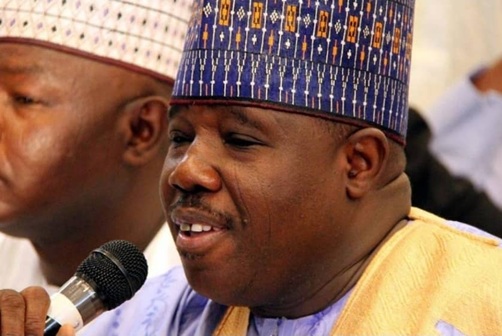
A grassroots support group mobilising for President Bola Ahmed Tinubu’s re-election in 2027 has threatened to withdraw its voluntary campaign support if former Borno State Governor and Senator, Ali Modu Sheriff, remains in the All Progressives Congress presidential campaign structure.
The group, identified as the Grassroots Movement for Tinubu Continuity Come 2027, said it remains committed to Tinubu’s re-election but cannot continue its grassroots mobilisation under an arrangement that places Sheriff at the forefront of the campaign in the North-East.
The group’s National Chairman, Sani Zangina, reportedly conveyed the position in a formal complaint dated August 25 and addressed to the APC National Chairman, Professor Nentawe Yilwatda.
Zangina said the organisation’s objection was specifically linked to Sheriff’s appointment as the North-East Zonal Campaign Coordinator in the APC Presidential Campaign Council for the 2027 election.
“Our support for the President remains unwavering, but we cannot continue to offer voluntary support under an arrangement that places Sheriff at the forefront of the campaign in the North-East,” the group stated.
The group’s opposition is centred on allegations that have historically linked Sheriff to Boko Haram. The organisation argued that his prominent position within Tinubu’s campaign could negatively affect the President’s image and weaken the confidence of grassroots supporters in the North-East.
It is important to note, however, that the allegations referenced by the support group are allegations and do not, by themselves, establish criminal responsibility.
Sheriff, a former senator and two-term governor of Borno State, has remained an influential figure in Nigerian politics. His political career has included leadership positions in different parties, including a period as acting national chairman of the Peoples Democratic Party before his eventual return to the APC.
The controversy over his role comes shortly after the APC unveiled a 223-member Presidential Campaign Council for the 2027 election, with President Tinubu as chairman, Vice-President Kashim Shettima and APC National Chairman Nentawe Yilwatda as vice-chairmen.
The composition of the campaign council has already generated criticism from other political actors and supporters of the President.
Former South-East spokesman for the Tinubu-Shettima Presidential Campaign Council, Denge Onoh, has also criticised the structure, alleging that some important APC stakeholders and longstanding supporters were marginalised.
Onoh reportedly questioned the absence of some grassroots and regional figures who played active roles during the 2023 presidential campaign, warning that the current arrangement could weaken Tinubu’s support base ahead of 2027.
The Presidency, however, has indicated that the campaign structure is not necessarily final.
President Tinubu’s Special Adviser on Media and Public Communication, Sunday Dare, said the released structure remains valid but could undergo adjustments as additional subcommittees are constituted.
According to Dare, the campaign council is still being expanded and more names could be included in various subcommittees.
The latest dispute therefore presents the APC with an early organisational challenge as it prepares for the 2027 presidential election.
For the Tinubu support group, the issue is not opposition to the President himself but dissatisfaction with the inclusion of a particular politician in a strategically important regional position.
The threat is significant because grassroots mobilisation groups often provide political parties and candidates with volunteers, community-level networks and campaign activities outside the formal party structure.
However, it remains unclear whether the threatened withdrawal would materially affect Tinubu’s electoral prospects in the North-East or whether the dispute can be resolved through adjustments to the campaign council.
The controversy also highlights the increasingly competitive nature of the 2027 election preparations, with supporters, political parties and campaign groups already scrutinising appointments and regional representation.
For the APC leadership, the immediate task will be to balance competing interests within the campaign structure while maintaining the loyalty of groups that helped mobilise support for Tinubu in the previous election.
With the formal campaign season still ahead, the dispute over Sheriff’s role could become an early test of the ruling party’s ability to manage internal disagreements without weakening its electoral machinery.
For now, the Tinubu support group has made its position clear: its support for the President remains intact, but its voluntary grassroots mobilisation could be suspended if Sheriff remains at the forefront of the North-East campaign structure.