

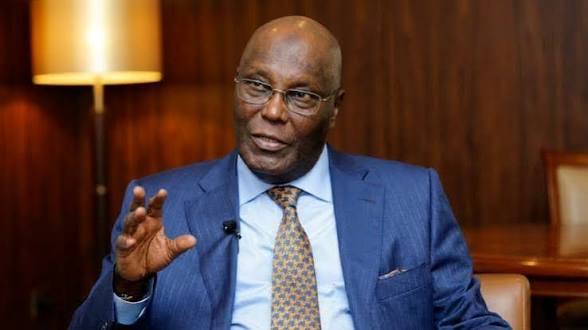
ABUJA — A legal firm, Sagitarian Law Firm, has formally petitioned the Economic and Financial Crimes Commission (EFCC) to reopen and prosecute an alleged financial crimes case involving former Vice President Alhaji Atiku Abubakar, citing what it described as findings contained in previous EFCC investigations and a 2010 report by a United States Senate committee.
The petition, dated August 27, 2026, was signed by Hannibal Egbe Uwaifo, SAN, MCArb, Mnim, Principal Counsel of Sagitarian Law Firm, and addressed to the Chairman of the EFCC at the commission’s headquarters in Jabi, Abuja.
The document bears an EFCC receiving stamp dated September 1, 2026, indicating that the commission formally received the petition.
Former lawmaker asks EFCC to revive case
According to the petition, the law firm is acting on the instructions of Hon. Ehiozuwa J. Agbonayinma, identified in the letter as a former member of the House of Representatives and former member of Nigeria’s Code of Conduct Bureau.
The petitioner is asking the EFCC to revisit an investigation allegedly conducted by the commission between 2005 and 2006 concerning then Vice President Atiku Abubakar.
The letter states that following the investigation, the EFCC produced a report titled “The EFCC Report on Vice-President Abubakar Atiku (Full Report)”, dated September 2006.
The lawyers allege that the report contained serious allegations relating to corruption, money laundering and other financial crimes involving Atiku and other persons.
Importantly, these are allegations contained in the petition and should not be treated as established criminal findings against Atiku unless and until competent authorities or a court of law determine otherwise.
Lawyers cite former vice-presidential immunity
The petition argues that although the EFCC had allegedly indicated its intention to prosecute Atiku after he left office, prosecution did not subsequently take place.
The lawyers contend that Atiku’s position as Vice President at the time constituted a constitutional immunity that prevented prosecution while he remained in office, but that the alleged immunity no longer applies.
The petition describes the continued failure to prosecute as what it calls a “deliberate dereliction of duty” by the anti-graft agency.
The lawyers further argue that the matter has generated public concern both within and outside Nigeria and contend that reopening it would demonstrate that the EFCC is prepared to pursue corruption allegations irrespective of the status of the individuals involved.
US Senate report also cited
A significant element of the petition is its reference to an investigation by a United States Senate Permanent Subcommittee on Investigations, Committee on Homeland Security and Governmental Affairs.
The lawyers claim that the US congressional investigation examined the same subject matter and produced a report dated February 4, 2010, which, according to the petition, contained allegations concerning money laundering and other financial crimes involving Atiku.
The petition does not itself provide the full US report or establish that every allegation cited in it was judicially proven.
However, the lawyers are asking the EFCC to retrieve and examine both the 2006 EFCC report and the 2010 US Senate report as part of the basis for reopening the matter.
“Nobody is above the law”
Making a broader argument about accountability, the lawyers contend that the case represents an important test of the anti-corruption agency’s willingness to investigate high-profile individuals.
The petition states that while the EFCC’s performance in other corruption cases has been commendable, the Atiku matter allegedly remains a reference point that, in the petitioner’s view, raises questions about the agency’s handling of corruption allegations involving politically influential persons.
The lawyers argue that prosecuting the case, if the evidence supports it, could reinforce the principle that “nobody is above the law.”
14-day ultimatum issued to EFCC
The petition concludes with a formal demand that the EFCC take action.
Sagitarian Law Firm gives the commission 14 days from the date of the letter to respond and act on the request.
The lawyers warn that if the EFCC “refuses or neglects to act” within the stipulated period, their client has instructed them to commence legal proceedings against the commission.
The petition therefore places the EFCC under renewed pressure to publicly clarify the status of the alleged historical investigation and whether it intends to reopen or prosecute any case arising from it.
Political significance
The petition comes at a politically sensitive period, with Atiku Abubakar remaining a prominent figure in Nigeria’s opposition politics and the 2027 general elections approaching.
Any decision by the EFCC to reopen a historical investigation involving a major opposition political figure would likely attract significant political and public attention.
At the same time, the existence of a petition does not establish criminal liability. The allegations referenced in the document would have to be independently investigated, and any prosecution would be subject to the applicable evidentiary and judicial processes.
For now, the key development is that a legal representative acting for a former federal lawmaker has formally asked the EFCC to reopen the alleged financial crimes case, review the 2006 EFCC report and the 2010 US Senate report, and consider prosecution, while threatening court action if the commission fails to respond within 14 days.
The EFCC is now faced with a demand to explain whether the allegations contained in the historical reports remain active, whether they were ever conclusively resolved, and whether the commission intends to take further action.


