

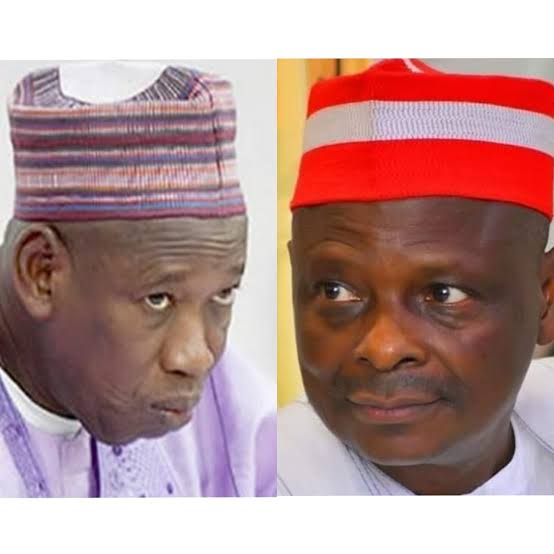
Kano State remains Nigeria’s most politically charged battleground, defined for over a decade by the unending rivalry between two dominant figures: Dr Abdullahi Umar Ganduje and Senator Rabiu Musa Kwankwaso. As the road to 2027 gradually comes into view, this local derby—rooted in personal fallout, ideological divergence, and mass mobilisation—continues to shape not just Kano’s political future but its influence on national outcomes.
In a Media chat with the BBC Hausa, Ganduje was quoted in Hausa language:
A shirye nake na shirya da Kwankwaso – Ganduje
Meaning; he Ganduje is ever ready for Kwankwaso.
The Ganduje–Kwankwaso rivalry is more than a clash of personalities; it is a contest for political soul and structure. Kwankwaso commands a formidable grassroots base through the Kwankwasiyya Movement, built on populist appeal, social welfare symbolism, and deep loyalty among urban youths and the talakawa. Ganduje, on the other hand, has consolidated elite power, party machinery, and federal alignment, culminating in his current position as national chairman of the APC.
This rivalry has polarised Kano into two political identities, leaving little room for neutral ground. Elections in the state are no longer driven primarily by policy debates but by allegiance to either camp. As a result, governance often takes a back seat to political survival, vendettas, and score-settling, with institutions dragged into factional battles.
For 2027, the implications are profound. First, Kano’s voting strength—one of the largest in the federation—means whoever controls the state wields significant leverage in presidential elections. Kwankwaso’s NNPP stronghold in Kano poses a direct threat to APC’s northern arithmetic, especially if the opposition succeeds in broader coalition-building. Conversely, Ganduje’s proximity to federal power gives the APC strategic tools to reclaim or neutralise the state.
Second, the rivalry risks deepening voter fatigue and political cynicism. Continuous tension, legal battles, defections, and counter-defections may dampen public trust, particularly if the electorate perceives politics as a perpetual personal feud rather than a vehicle for development.
Finally, Kano’s derby will test the future of issue-based politics in Nigeria. If 2027 in Kano once again revolves around Ganduje versus Kwankwaso, it will signal the persistence of personality-driven politics. But if a new political narrative emerges—centred on governance, economy, and social cohesion—it could redefine Kano’s role as not just a kingmaker, but a standard-bearer for democratic maturity.
As 2027 approaches, one question looms large: will Kano remain trapped in an endless derby, or will its people force a political reset beyond Ganduje and Kwankwaso? The answer may shape Nigeria’s next chapter.


