

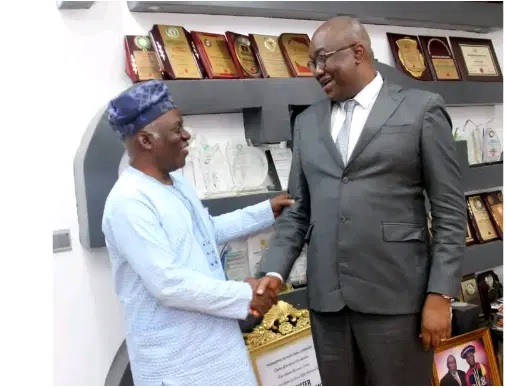
A fresh warning has emerged from Nigeria’s pro-democracy space as former presidential candidate Gbenga Hashim declared that democratic forces across the country will strongly resist any attempt to impose a one-party system.
Hashim made the statement following a strategic meeting with prominent human rights lawyer and Senior Advocate of Nigeria, Femi Falana, in what observers describe as a significant alignment between political and legal voices concerned about the future of Nigeria’s democracy.
Addressing the press after the meeting, Hashim emphasized that Nigeria’s democratic gains—achieved after years of struggle—must not be undermined by political dominance or suppression of opposition voices. He warned that any move toward a one-party state would be met with organized resistance from civil society groups, political actors, and citizens committed to democratic ideals.
“Nigeria’s democracy is built on plurality, competition, and the freedom of choice,” Hashim said. “We cannot and will not allow any attempt to reduce it to a one-party system.”
The remarks come at a time when Nigeria’s political landscape is witnessing shifting alliances, defections, and increasing consolidation of power within the ruling All Progressives Congress (APC). Critics have raised concerns that such trends, if unchecked, could weaken opposition parties and limit political diversity.
Falana, known for his long-standing advocacy for human rights and constitutional governance, is believed to have shared similar concerns during the meeting. While he did not publicly elaborate on the discussions, his involvement signals the legal community’s growing interest in safeguarding democratic institutions.
Analysts note that Nigeria’s history with military rule and authoritarian governance makes the preservation of a multi-party system particularly important. Since the return to civilian rule in 1999, the country has maintained a competitive political environment, though challenges such as electoral disputes, internal party conflicts, and governance issues persist.
Observers also point to recent political developments, including internal crises within opposition parties and the emergence of new coalitions, as factors shaping the current discourse. Some argue that these dynamics could inadvertently create conditions where a dominant party exerts disproportionate influence.
However, supporters of the ruling party reject claims of any deliberate attempt to establish a one-party system. They argue that political dominance, where it exists, is the result of electoral success and public support rather than coercion or manipulation.
Despite differing perspectives, Hashim’s statement has resonated with civil society organizations that have long advocated for transparency, accountability, and inclusive governance. Many see the call for vigilance as timely, particularly as Nigeria approaches another election cycle.
Political commentators suggest that the coming years will be critical in determining the strength and resilience of Nigeria’s democratic institutions. “Democracy is not just about elections,” one analyst noted. “It is about ensuring that multiple voices can compete freely and fairly.”
For now, the meeting between Hashim and Falana appears to mark the beginning of a broader conversation about the direction of Nigeria’s political system. Whether it translates into coordinated action remains to be seen, but the message is clear: any perceived threat to democratic plurality will not go unchallenged.
As Nigerians reflect on the state of their democracy, the emphasis on protecting a multi-party system underscores a fundamental principle—that the strength of a nation lies in the diversity of its voices and the freedom of its people to choose their leaders.


