

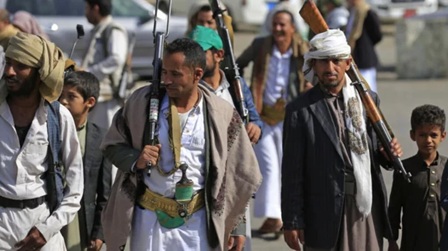
At least five people have been killed in renewed fighting involving Saudi Arabia, Yemen’s Houthi movement and forces loyal to Yemen’s internationally recognised government, as attacks across the Arabian Peninsula intensify.
Saudi Arabia’s Civil Defence agency said on Thursday that one person was killed and two others injured after debris from a Houthi drone fell in Taif governorate, east of Mecca. The person killed was identified as a Yemeni resident of Saudi Arabia, while the injured included a Saudi woman and a Pakistani resident. Several buildings and vehicles were also damaged.
The death is the first reported fatality in Saudi Arabia this month since the Houthis intensified their attacks against the kingdom.
The Saudi authorities said the drone had been intercepted and destroyed before the debris fell in Taif. The incident came a day after Riyadh accused the Houthis of launching a drone towards Mecca, Islam’s holiest city.
Saudi Arabia described the alleged attempt to approach the holy city as a serious violation and warned that attacks threatening the safety of Islamic holy sites would not be tolerated.
The Houthis, however, have rejected the accusation.
Houthi leader Abdel-Malik al-Houthi called the Saudi claim a “heinous lie” during a televised address on Thursday. He said the group respected the sanctity of Mecca and accused Saudi Arabia of using the allegation as propaganda to justify its military operations.
Casualties reported in Yemen
The fighting has also resulted in casualties inside Yemen.
Houthi-controlled Almasirah television reported that Saudi aircraft had targeted three telecommunications towers in Taiz province. It said one civilian was killed and another injured in strikes on the town of Abs.
The Houthi-backed outlet later reported that three children were killed and several other Yemenis injured in attacks attributed to forces aligned with Saudi Arabia and Yemen’s internationally recognised government.
The casualty figures from the Houthi-controlled media could not be independently verified, and Saudi authorities have not publicly confirmed the reported deaths.
The latest exchanges follow a sharp deterioration in Yemen’s conflict, with the Houthis making significant territorial gains and Saudi-backed government forces attempting to halt their advance.
The renewed fighting has also increased concerns about the security of regional energy and shipping routes.
Wider regional implications
The escalation is unfolding against the backdrop of the wider Middle East conflict involving Iran and its regional allies.
The Houthis are aligned with Iran, while Saudi Arabia supports Yemen’s internationally recognised government. The two sides had largely observed a fragile truce following a 2022 ceasefire, but hostilities have intensified again in recent weeks.
The Houthis have also threatened Saudi-linked maritime interests following their recent advances along Yemen’s Red Sea coast.
The development is particularly significant because the Bab el-Mandeb Strait, connecting the Red Sea with the Gulf of Aden, is one of the world’s major maritime chokepoints. Any sustained disruption could affect the movement of oil, gas and other commercial goods between the Middle East, Europe and Asia.
Saudi Arabia has also faced pressure on its alternative oil-export routes after attacks affecting infrastructure elsewhere in the kingdom.
Pakistan and Turkey drawn closer
The renewed attacks are also testing a recently established defence arrangement involving Saudi Arabia, Pakistan and Turkey.
The three countries signed the Makkah Joint Defence Agreement in August, committing to closer military and security cooperation. The agreement includes a collective-defence provision under which an armed attack against one member is to be regarded as an attack against all three.
Pakistan’s Defence Minister Khawaja Asif said on Thursday that the time had come to implement the agreement following the latest Houthi attacks.
However, Islamabad has not publicly detailed what military response, if any, it would undertake.
China has also reportedly appealed privately to Iranian officials to help restrain the Houthis after Saudi Arabia sought Beijing’s assistance. Publicly, Beijing has called for restraint, dialogue and the restoration of safe navigation in the region.
For now, the latest deaths underline the renewed human cost of Yemen’s conflict. With Saudi Arabia facing attacks on its territory and the Houthis expanding their military operations, the fighting risks becoming increasingly connected to the wider regional confrontation involving Iran and its allies.


