

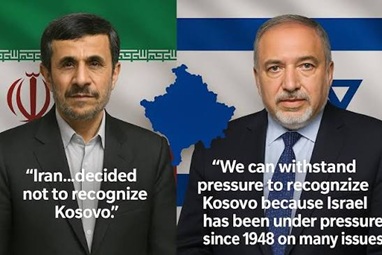
Kosovo’s growing relationship with Israel and its decision to participate in a United States-led framework for Gaza are being linked by analysts to Pristina’s longstanding strategic dependence on Washington and NATO.
Kosovo, a majority-Muslim country in the Balkans, has joined US President Donald Trump’s Board of Peace and the proposed International Stabilization Force for Gaza, following approval from Israel. The proposed force is expected, in principle, to support security, demilitarisation and the training of Palestinian police, although its precise mandate and composition remain unclear.
The decision has attracted particular attention because Kosovo’s own modern history is deeply connected to international military intervention and external security guarantees.
Kosovo was an autonomous province within Serbia until the late 1980s, when then-Serbian President Slobodan Milosevic stripped the territory of much of its autonomy. The resulting repression and political tensions contributed to the 1998–99 war, during which Serbian and Yugoslav forces carried out killings and mass expulsions of Kosovo Albanians.
More than 10,000 Kosovo Albanian civilians were killed during the conflict, according to the Al Jazeera report. NATO subsequently launched a 78-day air campaign against Yugoslav forces, after which Serbian and Yugoslav troops withdrew. NATO’s KFOR peacekeeping mission arrived in Kosovo in June 1999 and remains a major component of the territory’s external security architecture.
Nexhmedin Spahiu, a university professor and political analyst in Pristina, argues that Kosovo’s increasingly close relationship with Israel is partly connected to its dependence on American support.
“Kosovo’s moves towards Israel are the price of aligning with American policy,” Spahiu said, describing the relationship as a form of repayment for US assistance.
For many Kosovo Albanians, the United States remains associated with the NATO intervention, the return of refugees and the international circumstances that eventually enabled Kosovo to declare independence.
Serbia, however, continues to reject Kosovo’s independence, making US backing and NATO protection strategically important to Pristina.
From Washington to Jerusalem
Kosovo’s relationship with Israel took a major step forward through the Washington Agreement of September 2020.
As part of the agreement reached during Trump’s first presidency, Kosovo committed to establishing an embassy in Jerusalem. Israel subsequently recognised Kosovo in February 2021, and Pristina opened its embassy in Jerusalem the following month.
That made Kosovo the first majority-Muslim country to establish an embassy in Jerusalem, according to Al Jazeera.
Donika Emini, a research fellow at the University of Graz’s Centre for Southeast European Studies, described Israel’s recognition of Kosovo as an important diplomatic achievement for Pristina.
She said the relationship has since moved beyond diplomatic recognition towards a broader strategic partnership, including potential security cooperation.
Kosovo’s leadership has also viewed closer relations with Israel as part of a wider effort to strengthen its international position and its relationship with Washington.
Political analyst Artan Muhaxhiri described this dynamic as “proxy politics”, arguing that Kosovo’s relationship with Israel has been significantly shaped by its relationship with the United States rather than being entirely independent of Washington’s strategic priorities.
Kosovo seeks a new international role
Pristina has presented its proposed involvement in Gaza partly as an opportunity to contribute to international security.
Prime Minister Albin Kurti said in March that Kosovo was prepared to help Gaza because the territory had itself benefited from international forces following the Kosovo war.
Emini said Kosovo has long sought a greater role in international peace and security but faces limitations because it is not a member of the United Nations.
Participation in a US-led initiative, she argued, could give Kosovo greater international visibility and allow it to demonstrate that it can contribute to international security.
However, she also cautioned against drawing a direct comparison between Kosovo’s experience and the situation in Gaza, saying the political and security circumstances are fundamentally different.
Gaza creates a diplomatic dilemma
Kosovo’s position also presents a political and diplomatic tension.
The country’s national narrative emphasises international protection of civilians, opposition to repression and the principle of self-determination. At the same time, its participation in a Gaza framework in which Israel has a significant role has drawn scrutiny from analysts and Palestinian actors.
Emini said the debate in Pristina has increasingly focused not simply on whether Kosovo’s positions on Serbia and Gaza can be reconciled legally, but also on its strategic interests, its relationship with Washington and the alliances it hopes to build.
Kosovo’s decision therefore reflects a broader foreign-policy calculation involving security, diplomatic recognition and international integration.
While supporters can view participation in the Gaza initiative as an opportunity for Kosovo to contribute to international security, critics question whether its close alignment with Washington has constrained its ability to develop a more independent position on Israel and the Palestinian issue.
The debate illustrates the complicated choices facing smaller states whose security and international standing depend heavily on relationships with larger powers.


