

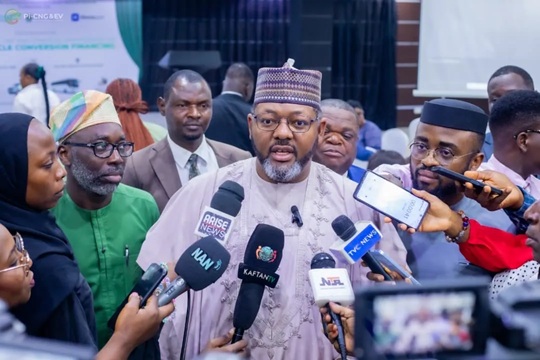
The Federal Government and state governments have agreed to work together to reduce transportation costs nationwide by leveraging cheaper Compressed Natural Gas and electric vehicles, with lower fares expected to begin from October 1, 2026.
President Bola Ahmed Tinubu disclosed this after discussions with the Nigeria Governors’ Forum on Thursday, saying the governors had resolved to take immediate measures to bring down transportation costs in their respective states.
Under the arrangement, the Federal and state governments will establish a joint committee to coordinate measures aimed at ensuring that savings from cheaper vehicle fuel are passed directly to commuters.
Tinubu said the initiative would focus particularly on intra-state transportation, where Nigerians experience the impact of rising transport costs most directly.
“I am pleased with my discussion with the Governors’ Forum this afternoon,” the President said, explaining that the governors had committed to using the cost advantages associated with CNG and electric vehicles to reduce fares.
The President’s announcement comes as the government continues its wider push to expand the use of CNG as an alternative to petrol following the removal of the petrol subsidy.
According to Tinubu, more than 120,000 vehicles have already been converted to CNG nationwide, while conversion kits for more than 100,000 additional vehicles are being processed.
He said the government was also expanding conversion centres and refuelling infrastructure to make CNG increasingly accessible to motorists and transport operators.
The Federal Government is also financing more than 100 gas infrastructure projects through the Midstream and Downstream Gas Infrastructure Fund. These include 15 CNG mother stations and 86 daughter stations, according to the President.
Tinubu further announced an additional rollout of 500 CNG refuelling stations, which would bring the total number of stations targeted under the programme to 1,000.
The expansion is intended to address one of the major challenges facing CNG adoption in Nigeria: inadequate refuelling infrastructure.
The President said vehicles operating on CNG could spend between 60 and 80 per cent less on fuel than comparable petrol-powered vehicles.
He argued that the savings should ultimately translate into lower transportation costs for Nigerians rather than remaining solely with vehicle operators.
“From October 1, our goal is that Nigerians begin to partake in those savings through lower transport fares,” Tinubu said, stressing that cheaper fuel should result in cheaper fares.
The government’s Presidential Initiative on CNG and Electric Vehicles has positioned cheaper and cleaner transportation as a major component of Nigeria’s energy-transition strategy. The initiative says more than 120,000 vehicles have been converted and hundreds of conversion centres established across the country.
The planned reduction in fares could provide relief to households that have faced a sharp increase in transportation expenses over the past few years.
Transportation costs have become a major component of household expenditure, particularly for workers, students and low-income earners who depend heavily on commercial buses, minibuses and tricycles.
Higher fares have also contributed to increased costs for businesses because transportation expenses are often passed through to the prices of goods and services.
However, the success of the latest initiative will depend heavily on how quickly states and transport operators implement the proposed reductions.
The government will also have to address practical challenges surrounding CNG availability, vehicle conversion costs, safety standards and the willingness of transport operators to pass fuel savings to passengers.
While CNG can significantly reduce fuel expenditure, the reduction in fares is not automatic. Other operating costs, including vehicle maintenance, spare parts, insurance, financing and road conditions, also influence the final price commuters pay.
The Federal Government and governors will therefore face pressure to ensure that the promised savings are reflected in actual fares rather than absorbed elsewhere in the transport chain.
The initiative also represents an important test of cooperation between the Federal Government and states.
Because intra-state transportation is largely influenced by state-level policies and local transport unions, state governments will play a crucial role in enforcing any fare reductions.
The October 1 target therefore gives governments only a short window to establish the necessary mechanisms and communicate clear fare structures to transport operators and commuters.
For Nigerians struggling with high living costs, the measure could offer meaningful relief if properly implemented.
For the government, it provides an opportunity to demonstrate that the transition away from petrol can deliver tangible benefits beyond changes in energy policy.
The ultimate test, however, will not be the number of CNG vehicles converted or refuelling stations constructed. It will be whether an ordinary commuter actually pays less to travel.
With the Federal Government and state governors now committing to that objective, Nigerians will be watching closely to see whether October 1 becomes the date when cheaper CNG finally translates into cheaper transport fares nationwide.