

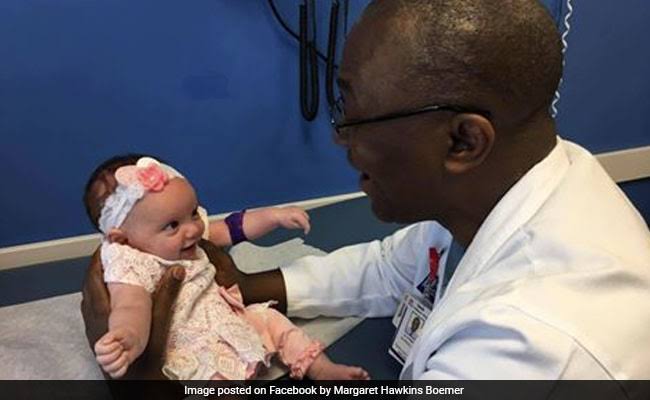
ABUJA — Nigerian-born paediatric and fetal surgeon, Dr. Oluyinka Olutoye, has gained international recognition for his role in a groundbreaking operation that saved the life of an unborn baby after doctors discovered a life-threatening tumour during pregnancy.

The extraordinary procedure, performed in 2016 at Texas Children’s Hospital in Houston, United States, involved temporarily removing the unborn baby from her mother’s womb, surgically removing most of a tumour, and then returning the baby to the womb so the pregnancy could continue.
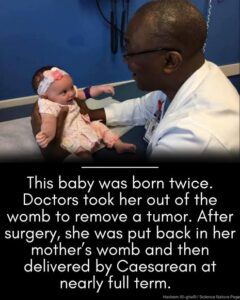
The child, Lynlee Hope Boemer, subsequently became known internationally as the “baby born twice.”
From Nigeria to advanced fetal surgery
Olutoye began his medical education in Nigeria at Obafemi Awolowo University, Ile-Ife, where he graduated with a medical degree in 1988.
He later relocated to the United States, where he underwent further specialist training in paediatric surgery and developed an interest in fetal surgery — a highly specialised branch of medicine involving the diagnosis and treatment of serious conditions affecting babies before birth.
His career eventually brought him to Texas Children’s Hospital, where he became involved in the treatment of complex fetal and paediatric conditions.
The unborn baby facing a deadly tumour
During Margaret Boemer’s pregnancy, doctors discovered that her unborn daughter had sacrococcygeal teratoma (SCT), a rare tumour that develops near the baby’s tailbone.
The tumour was growing rapidly and required a substantial blood supply. Doctors feared that the demand on the baby’s cardiovascular system could become fatal.
Faced with the potentially devastating consequences of allowing the tumour to continue growing, the family agreed to an extremely risky fetal operation.
At 23 weeks and five days of pregnancy, a team led by fetal surgeons including Olutoye and Dr. Darrell Cass performed open fetal surgery.
The doctors opened the mother’s uterus, partially delivered Lynlee, removed most of the tumour and carefully returned the baby to the womb.
The operation reportedly lasted about five hours and required close coordination among a large team of specialists.
‘And then the real work really starts’
Although the tumour was successfully reduced, the operation did not mark the end of the medical challenge.
Lynlee had to remain in the womb for several more weeks while doctors closely monitored both her condition and the pregnancy.
Olutoye later reflected on the moment, saying that after the operation, “the real work really starts.”
The pregnancy was eventually carried to approximately 36 weeks.
On June 6, 2016, Lynlee was delivered by Caesarean section, weighing about 5 pounds, 5 ounces.
Doctors subsequently performed another operation to remove remaining tumour tissue.
Her successful treatment transformed the case into one of the most widely publicised examples of fetal surgery and earned Lynlee the extraordinary description of the “baby born twice.”
A career beyond one historic operation
While the operation brought Olutoye global attention, it represented only one achievement in a career dedicated to paediatric and fetal medicine.
He later became a senior leader in paediatric surgery and fetal medicine, working on complex surgical conditions affecting children and unborn babies.
In 2019, Olutoye became Surgeon-in-Chief at Nationwide Children’s Hospital in Columbus, Ohio, where he continued his clinical, research and educational work.
His areas of expertise include paediatric surgery, fetal surgery and complex surgical care, while his professional work has also involved research, education and mentoring the next generation of surgeons.
Nearly a decade later
Lynlee’s story continues to be remembered as an extraordinary example of what can be achieved through advances in modern medicine.
Nearly a decade after the operation, the child who captured international attention for undergoing surgery before birth has grown into a symbol of the possibilities of fetal medicine.
For Olutoye, however, the historic operation was not simply a remarkable medical feat. It was part of a broader career devoted to expanding treatment options for children facing some of the most complex medical conditions.
His journey from medical school in Nigeria to the leadership of major paediatric surgical institutions in the United States also stands as a notable example of Nigerian medical expertise making an impact on the global stage.


