

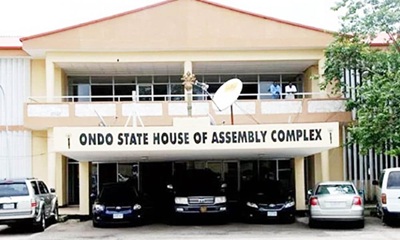
The ongoing leadership crisis in the Ondo State House of Assembly took a dramatic turn on Thursday as suspected thugs allegedly invaded the legislative complex in Akure, disrupting moves by lawmakers to impeach the Speaker, Olamide Oladiji.
The development occurred as members of the Assembly were preparing for a parliamentary meeting reportedly focused on the removal of the Speaker from office. A lawmaker who spoke on condition of anonymity alleged that the suspected thugs were brought to the Assembly to prevent lawmakers from proceeding with their plans.
According to the lawmaker, the men were confronted and eventually forced out of the premises by legislators. However, the incident reportedly prevented the lawmakers from holding the planned plenary session.
“He sent thugs to the Assembly to attack us,” the lawmaker alleged, adding that although the men were driven away, lawmakers decided not to proceed with plenary at the time.
The lawmaker, however, insisted that the impeachment effort had not been abandoned.
The crisis within the 26-member Ondo State House of Assembly has been building for several weeks, with a large majority of lawmakers reportedly backing efforts to remove Oladiji as Speaker.
As of the latest development, 21 lawmakers were reported to have signed a notice seeking the Speaker’s impeachment over allegations of financial misconduct.
One of the central allegations concerns the alleged diversion of N44 million meant for the reordering of the budget of the Ondo State Oil Producing Areas Development Commission.
The aggrieved lawmakers reportedly gave Oladiji a deadline to resign or face impeachment proceedings on the floor of the House.
The Speaker has not been convicted of any wrongdoing, and the allegations against him remain allegations pending investigation or judicial determination.
The latest confrontation has nevertheless raised concerns about the stability of the state legislature and the potential consequences of escalating political disagreements among elected representatives.
The situation became particularly tense after reports emerged that suspected hoodlums moved around the Assembly premises, creating fear among lawmakers and workers. Other reports indicated that some individuals were allegedly assaulted during the disturbance.
The incident has also revived concerns about the use of political thugs in disputes involving elected institutions.
Legislative proceedings are expected to be conducted through constitutional and parliamentary procedures, making any attempt to intimidate lawmakers or prevent them from carrying out their duties a serious concern for democratic governance.
The crisis has attracted the attention of the leadership of the All Progressives Congress in the state, which had previously intervened in an attempt to halt the impeachment process.
The party reportedly met with aggrieved lawmakers and urged them to suspend the move and resolve their differences through dialogue.
That intervention, however, appears not to have completely resolved the disagreement, with lawmakers continuing to discuss the Speaker’s future.
The latest confrontation could therefore complicate efforts by the APC leadership to broker a settlement.
For the lawmakers backing the impeachment, the allegations of financial misconduct must be addressed. For supporters of the Speaker, however, the proper constitutional and parliamentary procedures must be followed before any leadership change can take place.
The controversy also comes at a politically sensitive period, with political parties already positioning themselves ahead of the 2027 general elections.
A prolonged leadership crisis in the Assembly could affect legislative business and create further divisions within the ruling party in the state.
The immediate consequence of Thursday’s incident was the disruption of the planned parliamentary meeting, but the lawmakers have indicated that they intend to reconvene.
The anonymous lawmaker said the impeachment effort would continue despite the disruption, suggesting that the confrontation may not be the end of the crisis.
The Speaker’s position, meanwhile, remains a matter of intense political debate within the Assembly.
As the situation develops, attention will be focused on whether the lawmakers can resolve the dispute through constitutional procedures or whether further confrontations will occur.
The crisis has once again highlighted the importance of protecting legislative institutions from intimidation and ensuring that disagreements over political leadership are settled through the rule of law rather than force.
For Ondo State, the priority will now be to prevent the Assembly dispute from escalating into a broader political or security crisis while allowing any allegations of financial misconduct to be properly investigated and determined through due process.