

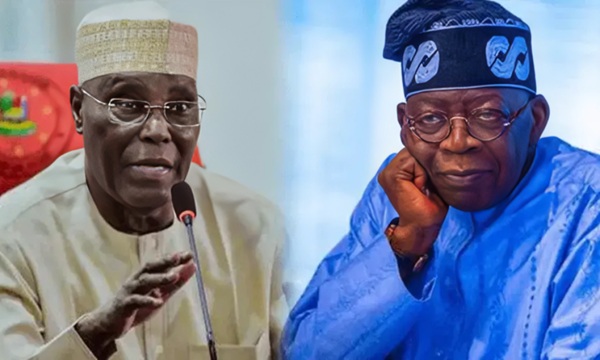
The political battle between former Vice President Atiku Abubakar and President Bola Tinubu has intensified, with the two camps trading accusations over petrol subsidy, public finances and the controversial $16bn power-sector expenditure linked to the administration of former President Olusegun Obasanjo.
The latest confrontation comes as political activities gather momentum ahead of the 2027 presidential election, with Atiku, the African Democratic Congress presidential candidate, increasingly focusing his campaign criticism on the economic consequences of the Tinubu administration’s reforms.
Atiku, in a statement issued on Wednesday through his Senior Special Assistant on Public Communication, Phrank Shaibu, challenged the Federal Government to investigate and prosecute him if it possesses evidence linking him to wrongdoing in the controversial power-sector spending.
The former Vice President accused the Tinubu administration of recycling allegations dating back nearly two decades in an attempt to divert attention from questions over the revenues generated following the removal of petrol subsidy.
Atiku said the National Assembly had previously investigated the power projects but that he was never invited to answer allegations of wrongdoing. He acknowledged that he chaired the National Council on Privatisation while serving as Vice President but maintained that he did not preside over the implementation of the power projects.
He challenged the government to produce evidence and take him to court if it believed he had committed an offence.
According to Atiku, the allegations had been repeatedly raised by successive administrations without resulting in prosecution, despite the government having access to the country’s investigative institutions.
The controversy surrounding the power expenditure dates back to the Obasanjo administration, when billions of dollars were committed to power-sector projects. A subsequent legislative investigation raised questions over the utilisation of the funds, while later reviews produced differing figures concerning the amounts budgeted, released and spent.
Atiku argued that reviving the issue at this point was politically motivated.
He instead demanded accountability over the money saved following the removal of petrol subsidy in 2023, asking the Federal Government to explain how the additional revenues had been utilised.
The former Vice President argued that Nigerians had endured steep increases in petrol prices, transportation costs and food prices since the subsidy was removed, while the government had promised that savings from the policy would be redirected towards development.
He questioned why Nigerians should continue to bear the economic burden of the reform without seeing commensurate improvements in their living conditions.
The Tinubu administration, however, has consistently defended subsidy removal as a necessary measure to reduce pressure on government finances and redirect resources towards infrastructure and other development priorities.
The President announced the end of the petrol subsidy shortly after assuming office in May 2023. The decision immediately triggered a major increase in petrol prices and intensified concerns over inflation and the cost of living.
The subsidy debate has now become one of the major political fault lines ahead of the 2027 election.
The Presidency has accused Atiku of presenting contradictory positions on whether he would restore the subsidy if elected.
In a statement titled “Atiku confused on petrol subsidy; third U-turn in one week shows he is simply playing politics,” Special Adviser to the President on Information and Strategy, Bayo Onanuga, said Atiku and his aides had offered different explanations of the proposed policy within a short period.
Onanuga said Atiku’s spokesperson, Paul Ibe, initially stated that the former Vice President would restore petrol subsidy if elected and eventually phase it out. Another aide, Phrank Shaibu, subsequently described that explanation as unauthorised, while Atiku later reaffirmed that he would restore what he called a targeted subsidy.
The Presidency argued that the conflicting explanations raised questions about the practicality and sustainability of Atiku’s proposal.
Onanuga challenged the ADC candidate to explain how much the proposed subsidy would cost, who would benefit, how beneficiaries would be identified, how the scheme would be funded and what economic conditions would determine its eventual termination.
The presidential aide also rejected the argument that petrol prices alone were responsible for Nigeria’s cost-of-living crisis, pointing to insecurity, exchange rates, logistics, storage challenges, flooding and agricultural input costs as other factors contributing to food inflation.
The clash has consequently moved beyond personal political rivalry into a broader debate over how Nigeria should manage its economy.
For Atiku, the issue is about accountability and whether Nigerians are receiving value from the sacrifices imposed by the subsidy removal.
For the Tinubu administration, the argument is about defending economic reforms and questioning the credibility of an opposition candidate proposing to reverse one of the government’s most consequential policies.
The ruling All Progressives Congress has also challenged Atiku to provide evidence for his allegations of corruption against political leaders, further escalating the rhetoric between the opposition and the governing party.
With the 2027 election approaching, the battle over subsidy and the management of public resources is likely to remain central to the campaigns.
Beyond the political accusations, voters will ultimately have to judge competing claims over whether subsidy removal has produced sufficient economic benefits, whether restoration is financially sustainable and whether either side can provide credible evidence of how public resources have been managed.
The latest confrontation therefore signals that the 2027 presidential contest is already becoming a battle not only over political power, but also over competing visions for Nigeria’s economic future.