

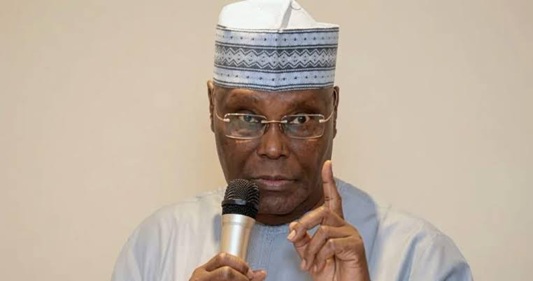
Former Vice President and African Democratic Congress presidential candidate, Atiku Abubakar, has said worsening economic hardship is pushing young Nigerians into dangerous and poorly regulated livelihoods as they struggle to meet basic needs.
Atiku made the remarks during a visit to Minna, Niger State, where he met families and survivors following the deaths of 37 suspected artisanal miners in the custody of the Nigeria Security and Civil Defence Corps.
The former vice president also announced a donation of N20m to support families affected by the incident. He said the deaths should prompt a broader discussion about poverty, unemployment and the economic pressures forcing young Nigerians to take increasing risks to survive.
The 37 suspected miners died on September 17 after being arrested during operations targeting suspected illegal mining activities in the M.I. Wushishi and Lukoto areas of Niger State.
The circumstances surrounding the deaths remain under investigation. President Bola Tinubu has ordered a probe, while senior NSCDC officials were suspended pending the outcome of investigations.
Reuters reported that survivors alleged that dozens of detainees had been held in an overcrowded cell and that an unidentified substance was sprayed into the facility before several detainees developed breathing difficulties and collapsed. The accounts could not independently be verified, and the cause of the deaths had not been conclusively established.
Speaking after meeting the affected families and survivors, Atiku said the immediate circumstances of the deaths required investigation, justice and accountability.
He also argued that attention should be paid to the economic circumstances that drive young Nigerians into hazardous occupations.
According to him, many young people are taking extraordinary risks because they lack access to sufficient employment and other sustainable sources of income.
“But beyond establishing what happened in that detention facility, we must also ask why so many of our young people are being pushed into dangerous and precarious livelihoods simply to survive,” Atiku said.
He said government economic policies should ultimately be assessed by their effect on households, workers and young people.
Atiku argued that when families struggle to afford basic necessities, young people may become increasingly willing to enter poorly regulated sectors where safety standards are limited.
Recent reporting from Plateau State has similarly documented young people and children working at informal mining sites, with some saying they entered the sector because they needed money for school fees or because other forms of casual employment did not provide enough income.
Atiku said the government should create conditions that allow young Nigerians to pursue legitimate and productive livelihoods rather than being driven towards hazardous activities.
He also reiterated his proposal for a targeted production subsidy for petroleum products refined in Nigeria, rather than a return to the previous open-ended subsidy on imported fuel.
According to him, supporting locally refined petroleum products could encourage domestic refining, create jobs and help reduce costs for consumers. He said his proposed approach would ensure that government support produces measurable benefits for Nigerians.
Atiku described the N20m donation as support for families affected by the Minna tragedy, while stressing that financial assistance alone could not address the broader economic issues facing young Nigerians.
He said Nigeria needed greater investment in education, skills, employment and productive opportunities to reduce the pressure forcing young people into dangerous occupations.
The former vice president also maintained that the deaths of the suspected miners should not be treated only as an isolated detention incident, but should trigger wider consideration of the social and economic conditions surrounding informal and artisanal mining.
The investigations into the deaths are expected to establish what happened in the detention facility and determine responsibility, while the wider debate over youth employment, poverty and hazardous informal work continues.
For Atiku, the incident highlights what he described as the need for government policies to translate into improved living conditions and viable economic opportunities for ordinary Nigerians.


