

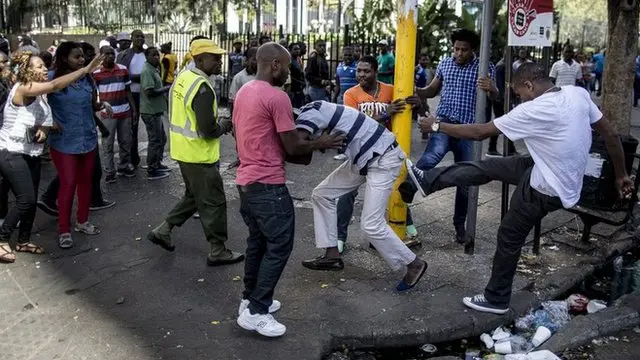
The images are disturbing yet familiar: foreign-owned shops looted, businesses set ablaze, families fleeing for safety, and innocent people hunted simply because of their nationality. Once again, South Africa finds itself trapped in the vicious cycle of xenophobic violence.
The question now is simple: What comes after the destruction?
When the smoke clears and the streets return to calm, South Africans will still have to confront unemployment, poverty, inequality, and crime—the very problems that fuel public frustration. Destroying businesses owned by foreign nationals does not create jobs. It destroys them.
South Africa has long been one of Africa’s largest economies because it attracted investment, entrepreneurship, and skilled labour from across the continent and beyond. Thousands of foreign nationals have established businesses, introduced new skills, paid taxes, created employment, and supplied goods and services in communities where opportunities were scarce. While South Africa’s economy depends on many contributors—including its own citizens, domestic firms, and international companies—forcing productive people and investors to leave risks weakening economic activity rather than strengthening it.
The immediate consequences are obvious. Businesses close, investments are withdrawn, supply chains are disrupted, and consumer confidence declines. Empty shops mean fewer goods in the market, reduced competition, and potentially higher prices for ordinary citizens.
But the longer-term consequences may prove even more damaging.
Investors, whether local or foreign, seek stability above all else. A nation where businesses can be attacked with little warning sends a dangerous signal to the international investment community. Capital is mobile. Once confidence is lost, investors simply move to countries where their assets, employees, and operations are better protected.
A decline in investment inevitably translates into slower economic growth, shrinking tax revenues, fewer employment opportunities, and greater pressure on government finances. As revenue falls, the state’s capacity to fund education, healthcare, infrastructure, housing, and social welfare also comes under strain.
The industrial sector may also feel the effects. Some foreign professionals, technicians, healthcare workers, engineers, traders, and entrepreneurs occupy roles that are difficult to replace immediately. Their departure could create skills shortages, disrupt productivity, and delay business expansion in certain sectors.
The diplomatic consequences should not be underestimated. Xenophobic attacks strain South Africa’s relations with neighbouring African countries whose citizens have repeatedly been targeted. Governments may respond with diplomatic protests, economic retaliation, or stricter treatment of South African businesses operating within their borders. The spirit of African solidarity and regional integration suffers every time innocent Africans are attacked because of their nationality.
Tourism, another vital contributor to South Africa’s economy, also stands to lose. International visitors are less likely to travel to destinations associated with recurring violence and social instability. Conferences, sporting events, and multinational corporations may reconsider South Africa as a preferred destination if concerns over safety continue to grow.
The social damage runs even deeper.
Xenophobia normalises violence as a means of expressing economic frustration. Once society accepts mob action against one group, it becomes easier for violence to spread to others. Communities become divided by suspicion, fear replaces trust, and neighbours become enemies. Such divisions weaken the social fabric upon which every stable democracy depends.
Even South Africans themselves ultimately bear the cost. Businesses destroyed during riots often employed local citizens. When those businesses close permanently, South Africans lose jobs alongside foreign nationals. Suppliers lose customers. Landlords lose tenants. Local governments lose tax revenue. Entire communities become poorer.
The irony is impossible to ignore. Those portrayed as competitors for economic opportunities are, in many cases, also contributors to economic activity. Their businesses purchase local products, rent local properties, employ local workers, and stimulate commerce. Their departure leaves economic gaps that cannot always be filled quickly.
South Africa stands today at a crossroads. It can either confront its socioeconomic challenges through sound governance, job creation, education, industrial growth, and effective law enforcement, or it can continue to search for scapegoats while the underlying problems worsen.
History offers a clear lesson: no nation has ever achieved lasting prosperity by attacking entrepreneurs, discouraging investment, or making productive people feel unwelcome.
The greatest threat to South Africa is not the foreigner seeking honest work or running a small business. The greatest threat is allowing anger, intolerance, and lawlessness to become substitutes for economic reform and responsible leadership.
If xenophobia persists, the victims will not only be foreign nationals. Ultimately, South Africa itself risks paying the highest price.


