

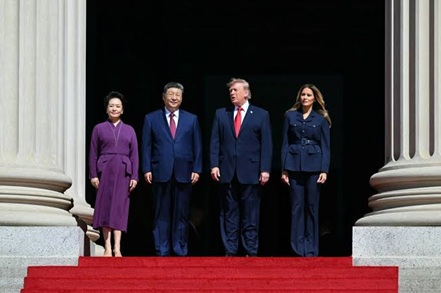
US President Donald Trump on Friday took Chinese President Xi Jinping to the National Archives in Washington, where the two leaders viewed some of the United States’ most important founding documents as Xi’s three-day state visit came to an end.
Trump and first lady Melania Trump accompanied Xi and his wife, Peng Liyuan, during the visit, where they viewed the Declaration of Independence, the US Constitution and other historic documents associated with the country’s system of government.
The National Archives visit served as a highly symbolic conclusion to Xi’s trip, which featured a state banquet, ceremonial events and several meetings with Trump.
The United States is marking the 250th anniversary of the Declaration of Independence this year, and Trump had earlier said he wanted to show Xi some of the country’s historic treasures.
While viewing the documents, Trump compared the age of the United States with China’s long history, saying America was 250 years old while China had thousands of years of history.
“We’re very proud of our 250,” Trump said while discussing the difference in the historical timelines of the two countries.
The symbolic display came against the backdrop of complicated relations between Washington and Beijing, with trade, artificial intelligence, Taiwan and the conflict involving Iran among the issues discussed during the visit.
Trump confirmed that he and Xi had discussed the war involving Iran. The US President was also asked about the prospects for reopening the Strait of Hormuz, a major route for global energy shipments, and expressed optimism about progress.
China has maintained economic ties with Iran, including continued purchases of Iranian oil, while Washington has sought to pressure Tehran over the conflict and its nuclear programme. The issue has therefore added another layer to the broader strategic competition between the United States and China.
Despite the geopolitical differences, Trump described his meetings with Xi in positive terms, saying the two countries had made progress in managing their relationship.
Xi also described the visit positively, saying it had added new substance to the understanding reached during his previous meeting with Trump in Beijing.
The Chinese leader said the two countries had agreed to pursue what he described as strategic stability based on respect, fairness and reciprocity.
However, the summit did not produce a major new agreement covering the most difficult areas of US-China competition. Reuters reported that Thursday’s summit appeared to produce no major breakthroughs, although Trump pointed to progress under an existing bilateral trade mechanism and both sides identified artificial intelligence as an area where cooperation could continue.
Trade remains one of the most important areas of tension between Washington and Beijing. The two countries have been operating under an uneasy trade truce following years of tariff disputes and retaliatory measures.
The leaders are also competing over advanced technologies, particularly artificial intelligence and semiconductor-related capabilities, while disagreements over Taiwan remain a major strategic issue.
Xi’s visit nevertheless produced plans for further high-level contact. He invited Trump and the first lady to China for the Asia-Pacific Economic Cooperation summit in Shenzhen in November. The two leaders could also meet at the G20 summit scheduled for December at Trump’s Doral resort in Miami.
“I do welcome you, Mr President and the First Lady, to visit China,” Xi said.
Trump responded that they would visit and would continue talking.
The Washington visit was Xi’s first trip to the US capital in more than a decade and marked another direct meeting between the two leaders since Trump’s return to the White House.
The National Archives ceremony therefore combined diplomacy with symbolism, placing the historical foundations of the American political system at the centre of the final public engagement between the two leaders.
As Xi departed Washington for Beijing, the two governments still faced substantial differences over trade, technology, Taiwan and Iran. The planned meetings later in the year will provide further opportunities for Washington and Beijing to manage those disagreements while maintaining direct communication between their leaders.


