

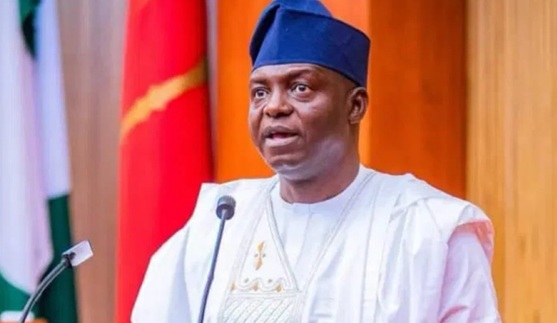
The National Chairman of the All Progressives Congress, Nentawe Yilwatda, has said more than 10 million vulnerable Nigerians who received ₦75,000 under the Federal Government’s conditional cash transfer programme do not have access to mobile phones, television or social media.
Yilwatda made the statement on Saturday while responding to journalists after a three-day retreat of the APC National Executive Council in Maiduguri, Borno State. He said the beneficiaries were among poor and vulnerable Nigerians reached through the Ministry of Humanitarian Affairs and Poverty Reduction.
According to the APC chairman, the absence of beneficiaries from online discussions partly explains why some Nigerians say they have not personally encountered people who received the government payments.
He argued that many of those targeted by the programme live outside the digital spaces where government policies are regularly debated and criticised.
Yilwatda said, “We have given 75,000 naira to over 10 million Nigerians across the country using the conditional cash transfer under the ministry of humanitarian affairs and poverty reduction.”
He added that many of the beneficiaries were unable to participate in public discussions because they lacked telephones, television sets and access to social media.
The statement comes amid continuing public debate over the scale, implementation and accountability of the Federal Government’s social intervention programmes.
In August, Humanitarian Affairs and Poverty Reduction Minister Bernard Doro said the Federal Government had disbursed more than ₦600 billion in cash transfers over a three-year period, reaching slightly more than 10 million households. The minister made the disclosure while discussing the government’s broader social protection programme.
The figures have, however, attracted scrutiny.
A report by the Auditor-General for the Federation said the government could not provide sufficient evidence that ₦33.75 billion transferred to more than 3.29 million vulnerable households in 2023 reached genuine beneficiaries. The audit covered transactions involving the National Cash Transfer Office and identified weaknesses in its internal control systems.
The audit findings are separate from Yilwatda’s latest statement and do not establish that the beneficiaries he referred to did not receive their payments. They do, however, illustrate the broader questions surrounding verification, documentation and monitoring of cash-transfer schemes.
Yilwatda linked the cash-transfer programme to measures introduced following the removal of the petrol subsidy. He said the administration had also invested in road construction, student loans and other programmes intended to reduce economic hardship.
The APC chairman also defended the subsidy-removal policy, arguing that reversing it could affect government spending on ongoing projects and programmes. He said states had previously struggled to meet salary and pension obligations and questioned the consequences of restoring the subsidy.
His comments came during an APC retreat that also focused on the party’s organisation ahead of the 2027 general elections. Yilwatda said the party reviewed its structures from the national level down to states, local governments, wards and polling units.
He said the party had also resolved to strengthen reconciliation efforts within its state chapters where internal disagreements existed.
The retreat ended with the APC National Executive Council expressing confidence in President Bola Tinubu, Vice President Kashim Shettima and other party candidates for the 2027 elections, according to reports of the meeting.
Meanwhile, Yilwatda’s comments about cash-transfer recipients have renewed attention on the challenge of measuring the impact of social programmes among Nigerians who have limited access to digital communication.
While the government says the interventions are designed to support vulnerable households, questions about beneficiary verification, payment mechanisms and independent monitoring remain part of the wider public discussion surrounding Nigeria’s social protection programmes.


