

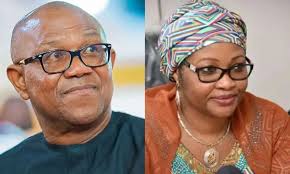
The leadership crisis and political realignments within Nigeria’s opposition space took a sharper turn on Thursday as Nenadi Usman, Chairman of the Labour Party (LP), declared that it would be “too late” for former presidential candidate Peter Obi to return to the party ahead of the 2027 general elections.
Usman’s remarks come amid ongoing political shifts following Obi’s earlier departure from the Labour Party, a move that reshaped opposition dynamics and triggered debates about the future of the party that saw an unprecedented surge in popularity during the 2023 elections.
Speaking on the issue, Usman emphasized that the Labour Party has moved forward and is focused on consolidating its structures, strengthening internal cohesion, and preparing for the next electoral cycle without reliance on any single individual.
“The party cannot remain stagnant waiting for one person,” she reportedly stated, adding that political organizations must prioritize institutional strength over personal ambitions.
Obi, who was the Labour Party’s presidential flagbearer in 2023 and garnered millions of votes nationwide, has since aligned himself with the African Democratic Congress (ADC), where he is now widely regarded as a leading figure in an emerging opposition coalition.
His departure from the Labour Party followed internal disputes and leadership challenges that analysts say weakened the party’s unity after its surprising electoral performance. The party, once energized by a strong youth-driven movement known as the “Obidient” wave, has since struggled to maintain the same level of cohesion and national momentum.
Usman’s statement appears to draw a clear line under any speculation about a possible reconciliation. Political observers interpret her remarks as a signal that the Labour Party is determined to chart an independent course, even if it means parting ways permanently with one of its most prominent figures.
Reactions to the statement have been mixed. Some party loyalists have welcomed the stance, arguing that it reinforces discipline and institutional integrity. They contend that allowing high-profile figures to exit and re-enter at will could undermine party stability.
However, others believe the decision could have broader implications for the opposition’s chances in 2027. Analysts warn that fragmentation among opposition parties may benefit the ruling All Progressives Congress (APC), which remains a dominant force in Nigeria’s political landscape.
“Unity is often the deciding factor in competitive elections,” a political analyst noted. “If opposition forces fail to coordinate effectively, it could dilute their electoral strength.”
Meanwhile, supporters of Obi have continued to express confidence in his political trajectory, particularly within the ADC, where coalition-building efforts are ongoing. His recent engagements with political stakeholders and international figures have been interpreted as part of a broader strategy to position himself for another presidential run.
Despite the growing distance between Obi and the Labour Party, the debate underscores a larger issue within Nigerian politics—the balance between individual influence and institutional continuity.
As the countdown to the 2027 elections gradually begins, political parties are expected to intensify internal restructuring, alliance-building, and candidate positioning. For the Labour Party, the message from its leadership is clear: its future will be defined by collective strength rather than reliance on past figures.
Whether this approach will strengthen or weaken its electoral prospects remains to be seen, but one thing is certain—the political landscape is already shifting, and the battle lines for 2027 are steadily being drawn.


