

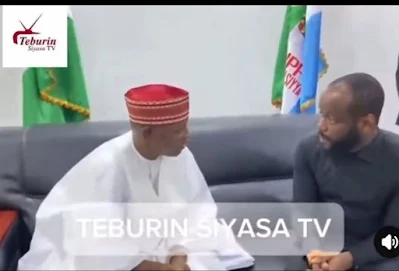
Kano State Governor, Abba Kabir Yusuf, is said to be carrying a heavy political burden as he weighs a possible defection to the All Progressives Congress (APC)—a move that, if consummated, would represent a dramatic rupture with the political will and legacy of his long-time benefactor, Rabiu Musa Kwankwaso.
Political sources in Abuja and Kano confirm that Yusuf recently held a closed-door meeting with Seyi Tinubu, a development that has intensified speculation that the governor may be preparing to realign with the ruling party amid mounting internal and external pressures. Though neither party has officially confirmed the meeting, the timing and secrecy surrounding it have sent shockwaves through Kano’s political establishment.
For Governor Yusuf, the moment is being described by close aides as one of profound personal and political conflict. His rise to power was inseparable from Kwankwaso’s political machinery and the unwavering loyalty of the Kwankwasiyya movement. Any move toward APC would therefore not be seen merely as defection, but as a deep betrayal of political trust, one that cuts to the heart of Kano’s political identity over the last decade.
Insiders say the governor feels increasingly cornered. Since assuming office, Yusuf has reportedly faced relentless pressure—from federal power brokers, institutional constraints, and quiet sabotage within the broader opposition fold. Allies who once championed his mandate are said to have grown distant, while governance in a politically charged Kano has become a daily battle for relevance and survival.
The reported engagement with Seyi Tinubu is viewed in some quarters as a survival consultation, not ideological conversion. Analysts argue that Yusuf’s calculations may now be driven less by loyalty and more by the harsh realities of power in Nigeria’s centralised political system, where alignment with the centre often determines access, protection, and political longevity.
Yet, the cost of such a move is immense. To go against Kwankwaso’s will is to risk alienating a fiercely loyal grassroots base that sees Kwankwasiyya not just as a political platform, but as a movement forged in sacrifice and resistance. For many supporters, Yusuf’s potential shift to APC would feel like abandonment—an unforgivable breach of trust.
As silence persists from all sides, the tension grows. Kano watches closely, aware that the governor stands at a historic crossroads: remain bound by loyalty and legacy, or cross over in pursuit of political insulation and federal accommodation.
Whatever decision Governor Abba Yusuf takes in the coming days, one truth is unavoidable—the weight of betrayal, real or perceived, will follow him. And in Kano politics, such weight can redefine careers, movements, and the balance of power itself.


