
A strongly worded political commentary by Ogbuefi Ndigbo has ignited renewed debate over the future of the South-East in Nigeria’s power equation, accusing prominent Igbo political leaders of undermining the region’s presidential aspirations through what the author describes as “defeatist rhetoric.”
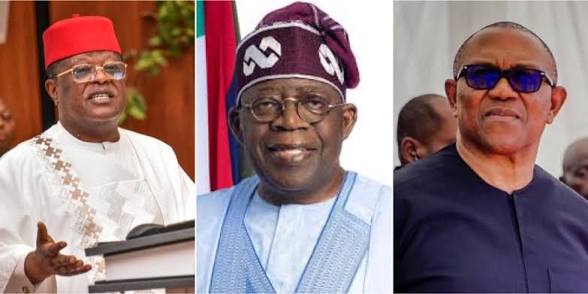
The article specifically criticises , Nigeria’s Minister of Works, and , Senator representing Abia North, over public statements suggesting that the South-East lacks the electoral strength to produce Nigeria’s president without extensive support from other regions.
According to the opinion writer, while coalition-building is an unavoidable reality in Nigeria’s political system, repeatedly emphasising the numerical weakness of the South-East before negotiations even begin amounts to weakening the region’s bargaining position. The article argues that such public declarations reinforce long-standing perceptions of political marginalisation and reduce the confidence of younger generations in the possibility of producing a Nigerian president from the region.
The commentary references previous remarks by , who had argued that the South-East must accept political realities and cultivate stronger alliances with other geopolitical zones. Umahi is said to have echoed similar sentiments, describing those views as having been validated by political developments.
While acknowledging that no single geopolitical zone has ever produced a president without broad national alliances, the author insists that successful political negotiations begin with confidence rather than self-deprecation. According to the article, influential leaders from the South-West, Northern Nigeria and the South-South rarely publicly describe their own regions as politically incapable. Instead, they consistently project their regions as indispensable stakeholders in Nigeria’s governance and negotiate from positions of perceived strength.
The commentary argues that this difference in political messaging has contributed to the influence enjoyed by those regions in national politics. In contrast, it claims that repeated public assertions questioning the South-East’s electoral viability risk diminishing the region’s political relevance even before coalition discussions commence.
The article also revisits the 2023 presidential election, citing the campaign of as evidence that an Igbo candidate can attract significant nationwide support beyond the South-East. According to the writer, Obi’s electoral performance demonstrated that regional aspirations can evolve into national movements when supported by effective organisation, strategic messaging and broad-based coalition-building.
Beyond electoral arithmetic, the commentary raises broader concerns about representation, equity and the principle of power rotation in Nigeria’s democracy. The author contends that the South-East, despite being one of Nigeria’s major geopolitical zones with a vibrant entrepreneurial population, a globally influential diaspora and substantial economic contributions, deserves equal opportunity to aspire to the nation’s highest office.
The writer further questions whether some political leaders have prioritised personal relationships with the federal government over collective regional interests. While acknowledging that political pragmatism often requires compromise, the article argues that such pragmatism should not come at the expense of diminishing the political dignity or long-term aspirations of the people they represent.
Concluding the piece, the author calls on South-East political leaders to abandon narratives perceived as limiting the region’s potential and instead focus on building credible alliances, strengthening political institutions and advocating for equitable power sharing within Nigeria’s federal system. According to the article, genuine leadership requires inspiring confidence, protecting the political interests of one’s constituents and negotiating national partnerships from a position of dignity rather than perceived weakness.
The commentary reflects the views of its author, Ogbuefi Ndigbo, and forms part of the continuing national debate over zoning, federal inclusion, coalition politics and the future of the South-East in Nigeria’s democratic process.
The Defeatist Chorus from Within: Opinion Writer Faults Umahi, Kalu Over Remarks on South-East’s Presidential Ambition

- Advertisement -

