

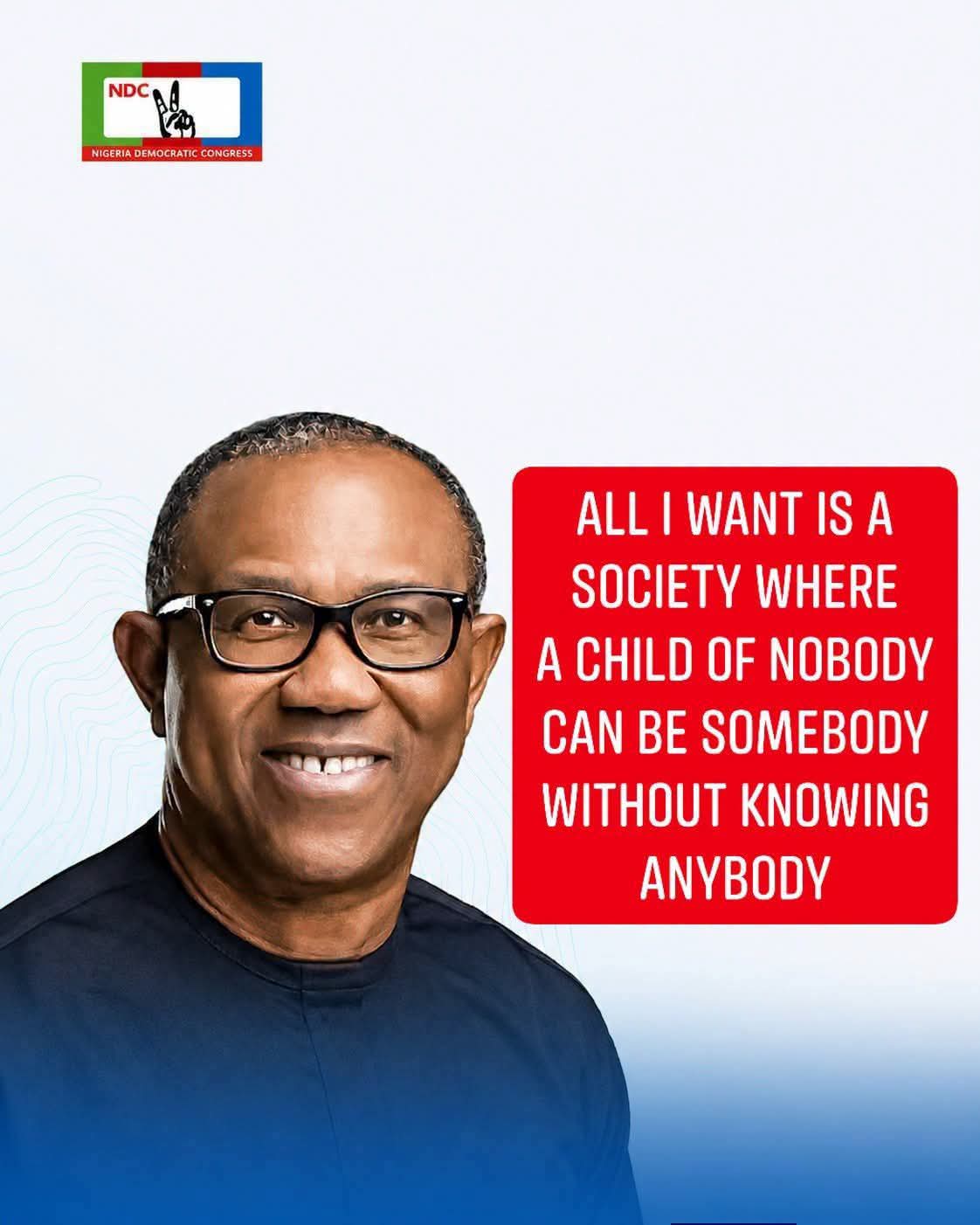
Few politicians in Nigeria’s Fourth Republic have generated as much admiration, criticism, and political conversation as Peter Gregory Onwubuasi Obi, CON. To his supporters, he represents prudent leadership, accountability, and a break from Nigeria’s entrenched political culture. To his critics, he is an experienced establishment politician whose image often exceeds his record.
Regardless of political leanings, one fact remains difficult to dispute: Peter Obi has become one of the most consequential figures in contemporary Nigerian politics, fundamentally reshaping opposition politics, youth participation, and the national conversation about governance.
From Business Executive to Political Leader
Born on July 19, 1961, in Onitsha, Anambra State, Peter Obi was raised in a devout Catholic family. He studied Philosophy at the University of Nigeria, Nsukka, before attending executive leadership programmes at prestigious institutions including Harvard Business School, Lagos Business School, and Cambridge Judge Business School.
Before entering politics, Obi built a successful career in business, serving on the boards of several companies, including as Chairman of Fidelity Bank. His corporate background would later shape his reputation for fiscal discipline and prudent management in public office.
His political journey began in 2003 when he contested the Anambra State governorship election under the platform of the All Progressives Grand Alliance (APGA). Although initially declared defeated, a prolonged legal battle culminated in a landmark Court of Appeal judgment in 2006 that declared him the rightful winner, ushering him into office as governor.
Eight Years That Defined His Political Identity
Peter Obi governed Anambra State from 2006 to 2014, despite suffering a controversial impeachment in 2006 that was later overturned by the courts.
Throughout his administration, Obi consistently projected an image of discipline, transparency, and prudent financial management.
His government prioritized education, healthcare, infrastructure, and institutional reforms while aligning several initiatives with the United Nations Millennium Development Goals.
Among the achievements frequently credited to his administration are the return of mission schools to churches and missionary organizations, a policy supporters argue significantly improved educational standards across Anambra State.
His administration also invested heavily in roads, healthcare facilities, and public institutions while maintaining relatively conservative spending patterns compared to many state governments of the period.
Supporters often point to reports that Obi left office with substantial financial reserves and reduced state debt, arguing that his tenure demonstrated that public resources could be managed responsibly without sacrificing development.
One of the documents that continues to reinforce this reputation is a letter dated May 8, 2007, in which Obi formally declined the allocation of two government plots of land offered to him as governor.
In the letter addressed to the Managing Director of the Anambra State Housing Development Corporation, Obi wrote that accepting the plots would amount to benefiting personally from public office.
“I became the Governor because I wish to serve my people,” he stated, adding that he believed he had to distance himself from “undue privileges of the office.”
The letter has resurfaced repeatedly over the years as supporters cite it as evidence of the ethical standards he sought to uphold while in office.
Criticism Never Disappeared
Despite widespread praise, Obi’s tenure was not without controversy.
His 2006 impeachment exposed deep political divisions within Anambra State, although the courts eventually ruled that the process violated constitutional provisions and restored him to office.
Years later, his name surfaced in the Pandora Papers investigation concerning offshore business interests. Obi denied any wrongdoing, maintaining that the companies were lawful investments established before assuming office and that he complied with applicable legal requirements.
Critics have also questioned whether his administration emphasized fiscal conservatism at the expense of more ambitious infrastructure expansion, while others have argued that some of the achievements attributed to him have been overstated in political discourse.
These debates continue to shape assessments of his legacy.
The Birth of the Obidient Movement
Peter Obi’s national political profile expanded significantly in 2019 when he became the Peoples Democratic Party’s vice-presidential candidate alongside Atiku Abubakar.
However, it was his decision to join the Labour Party in 2022 that transformed him into a national political phenomenon.
Running for president in 2023 on promises of competent leadership, prudent governance, security reforms, and production-driven economic policies, Obi inspired an unprecedented grassroots movement known as the Obidient Movement.
Driven largely by young Nigerians, professionals, students, and first-time voters, the movement relied heavily on social media campaigns, volunteer networks, fundraising initiatives, and community mobilization.
Although Obi finished third in the election with more than six million votes, behind Bola Ahmed Tinubu and Atiku Abubakar, many political analysts regarded the campaign as one of the most significant disruptions to Nigeria’s traditional two-party dominance.
The Labour Party, previously considered a fringe political platform, emerged as a major national force, while youth participation in politics reached levels not seen in decades.
A New Political Chapter
Following the 2023 election, Obi remained one of the country’s most vocal opposition leaders.
He consistently criticized government policies on fuel subsidy removal, inflation, exchange-rate reforms, insecurity, and economic management while continuing to advocate production-led economic growth and investment in education and healthcare.
His political journey also reflected the fluid nature of Nigerian party politics.
After leaving the Labour Party, he briefly aligned with the African Democratic Congress before joining the Nigeria Democratic Congress (NDC) in 2026.
The NDC subsequently adopted him as its presidential candidate for the 2027 election, with former Kano State Governor Rabiu Musa Kwankwaso selected as his running mate.
Fresh Legal Battles
Obi’s new political platform soon encountered legal challenges.
In June 2026, the Federal High Court sitting in Lokoja set aside an earlier judgment that had facilitated the registration of the NDC, citing procedural deficiencies relating to parties that were not joined in the original suit.
The decision generated widespread political reactions.
Obi and the NDC described the ruling as a setback for democratic participation and announced plans to challenge it on appeal, arguing that it threatened the rights of citizens to freely organize politically ahead of the 2027 elections.
The case has become one of the defining legal disputes shaping Nigeria’s evolving political landscape.
Beyond Elections
Peter Obi’s influence extends well beyond electoral contests.
He has become a central figure in conversations about public accountability, fiscal responsibility, and governance.
His supporters regard him as an embodiment of integrity and disciplined leadership, pointing to his lifestyle, financial prudence, and emphasis on measurable governance outcomes.
His critics, however, question aspects of his political evolution, including multiple party changes and whether his policy proposals sufficiently address Nigeria’s complex economic and security challenges.
These contrasting perceptions have made Obi one of Nigeria’s most polarizing political personalities.
Looking Ahead to 2027
As preparations intensify for the 2027 general election, Peter Obi remains a formidable opposition figure.
His success will likely depend on several critical factors: resolving legal uncertainties surrounding the NDC, retaining the enthusiasm of the Obidient Movement despite changes in party affiliation, expanding his appeal beyond his traditional support base, and presenting detailed policy alternatives capable of convincing a broader cross-section of Nigerians.
Whether viewed as a reformer, an establishment insider, or a symbol of political change, Peter Obi has undeniably altered Nigeria’s democratic landscape.
His political journey illustrates both the possibilities and the enduring challenges of reform-oriented politics within one of Africa’s most complex democracies. As the nation moves toward another pivotal election cycle, his influence is expected to remain central to debates about leadership, accountability, and the future direction of Nigeria.


