

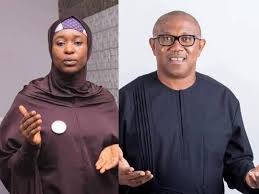
Nigerian activist and outspoken social commentator Aisha Yesufu has clarified her relationship with former Labour Party presidential candidate Peter Obi, stating that he is her “principal” and not her political godfather.
Yesufu made the statement while responding to growing public discussions and online reactions regarding her support for Obi and her involvement in political advocacy linked to the Labour Party movement.
The activist explained that her relationship with Peter Obi is based on shared values, accountability, and a common vision for better governance in Nigeria rather than political patronage or personal loyalty often associated with godfatherism in Nigerian politics.
“Peter Obi is not my godfather,” Yesufu said during a recent interview and online discussion. “He is my principal because I believe in the values and leadership style he represents.”
Her remarks have since generated widespread reactions on social media, with supporters praising her clarification while critics continued debating the influence of political personalities in Nigeria’s evolving democratic environment.
Aisha Yesufu became one of the most visible supporters of Peter Obi during the 2023 presidential election campaign. She played an active role in mobilizing young voters and advocating for political participation through social media campaigns, public engagements, and grassroots activism.
The activist, who is also known for her involvement in the Bring Back Our Girls movement, has consistently advocated for transparency, accountability, and citizen participation in governance.
Her support for Obi during the election period made her one of the leading voices within the Obidient Movement, a political support base largely driven by young Nigerians seeking reforms and alternative leadership.
However, critics and political opponents have frequently questioned the independence of some prominent supporters of political figures, leading to accusations of political loyalty driven by personal interests or patronage.
Responding to such claims, Yesufu insisted that her support for Peter Obi remains issue-based and rooted in her belief that Nigeria requires competent and accountable leadership.
She also stressed that she maintains the right to criticize any political leader whenever necessary, regardless of personal relationships or political affiliations.
“I do not worship politicians,” she reportedly stated. “Support should be based on competence, integrity, and service to the people.”
Political analysts say her comments reflect growing efforts by many young Nigerians to distance themselves from traditional political structures associated with godfatherism and elite control.
Godfatherism has remained a major topic in Nigerian politics for decades, with influential politicians often accused of controlling political structures, candidate selection, and governance decisions through personal networks and financial influence.
Observers believe the emergence of movements such as the Obidient Movement reflects a shift among younger voters who increasingly prefer issue-based politics over traditional patron-client political systems.
Peter Obi, a former governor of Anambra State, gained significant support among urban youths, professionals, and first-time voters during the 2023 presidential election. His campaign focused heavily on economic reforms, transparency, production-driven governance, and reducing corruption.
Although Obi did not win the presidential election, political analysts say his campaign significantly reshaped political conversations in Nigeria and increased youth participation in democratic processes.
Meanwhile, reactions to Yesufu’s comments continue to trend online, with supporters applauding her for distinguishing between political support and political dependency.
Some social media users described her remarks as a reflection of changing political attitudes among younger Nigerians who increasingly demand accountability from leaders instead of unconditional loyalty.
Others, however, argued that strong public support for political figures can sometimes resemble personality-driven politics regardless of the language used.
Political commentators note that the debate highlights broader discussions about leadership, political engagement, and democratic culture in Nigeria.
Experts also believe that conversations around political accountability and independent civic participation are likely to become more prominent as Nigeria approaches future elections.
The Labour Party and its support base continue to remain active in national political discussions despite the conclusion of the 2023 elections. Analysts say the movement’s influence could shape opposition politics and youth engagement ahead of the next electoral cycle.
For now, Yesufu’s remarks have added another dimension to ongoing national conversations about political loyalty, civic activism, and the future of issue-based politics in Nigeria.


