

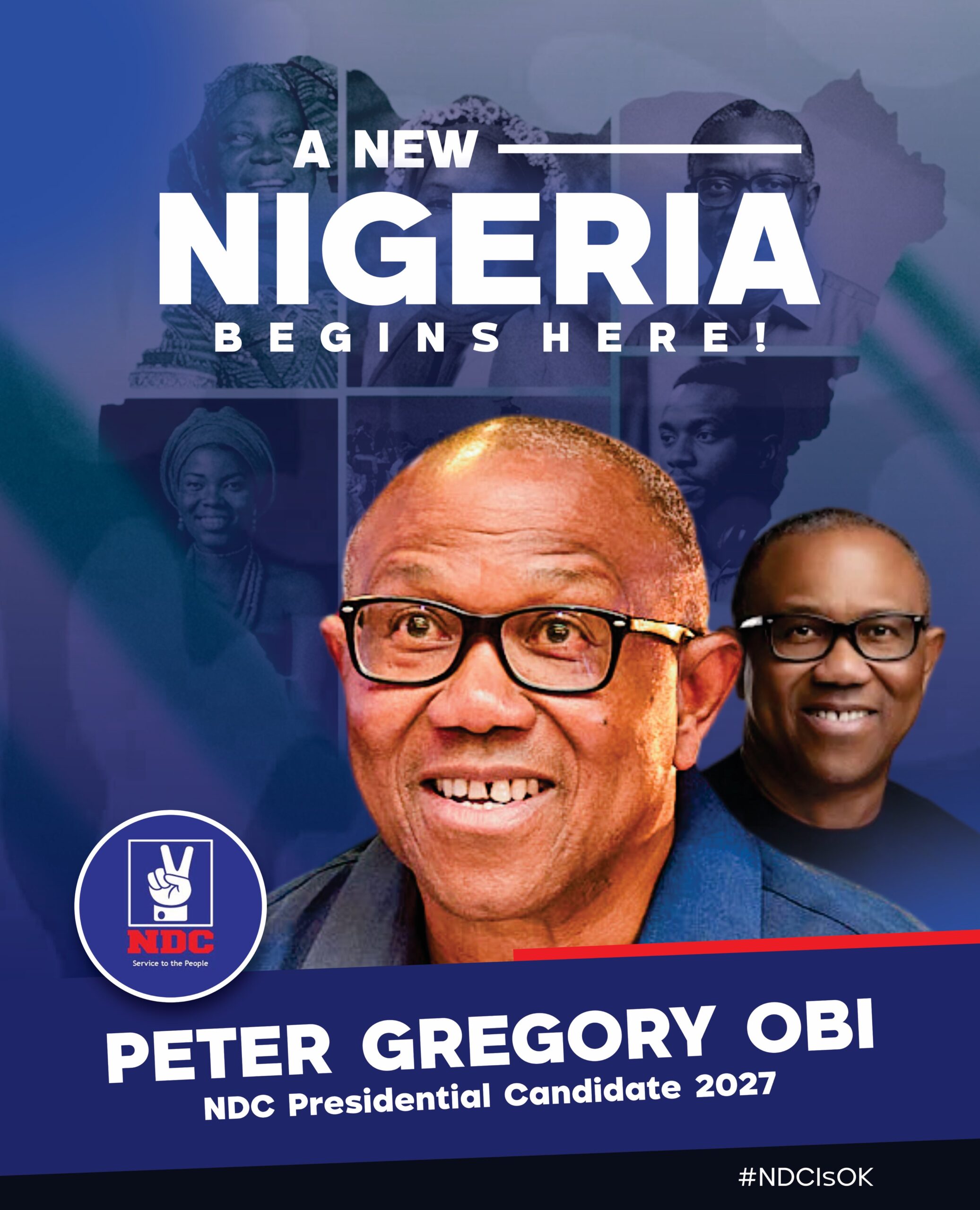
Former Anambra State governor Peter Obi has been affirmed as the presidential candidate of the Nigeria Democratic Congress (NDC) for the 2027 general election following the party’s national convention in Abuja.
The convention, attended by delegates, party officials, and supporters from across the country, formally ratified Obi’s candidacy after he emerged as the party’s sole presidential aspirant.
The event marked a significant milestone for the relatively new political platform, which has attracted several high-profile politicians in recent months.
Among those present was former Kano State governor Rabiu Musa Kwankwaso, who recently joined the NDC alongside Obi after their departure from the African Democratic Congress (ADC).
Addressing delegates at the convention, NDC National Leader Henry Seriake Dickson emphasized party unity and urged members to avoid the internal disputes and litigation that have weakened several political parties in Nigeria.
Dickson described the convention as a demonstration of the party’s commitment to democratic processes and consensus-building ahead of the 2027 elections.
Supporters celebrated Obi’s emergence, citing his popularity among young voters, urban professionals, and reform-minded Nigerians. Many argued that his candidacy provides the NDC with a strong platform to challenge the ruling All Progressives Congress (APC) in the next election cycle.
Party members also highlighted the NDC’s decision to zone its presidential ticket to the South, a move they believe promotes political balance and inclusivity.
Despite the celebratory atmosphere, some critics raised concerns about aspects of the party’s internal processes.
Activist Aisha Yesufu reportedly criticized certain primary elections within the party, describing them as imperfect, though she acknowledged the importance of maintaining unity for the broader political objective of challenging the APC in 2027.
Similarly, actor and politician Kenneth Okonkwo alleged irregularities in parts of the process, adding to ongoing debates about internal democracy within emerging opposition platforms.
Nevertheless, the convention concluded with delegates overwhelmingly backing Obi and reaffirming support for the party’s leadership.
Political analysts say Obi’s emergence further reshapes Nigeria’s opposition landscape and sets the stage for an increasingly competitive build-up to the 2027 presidential election.
Observers note that the ability of the NDC to maintain unity among its growing coalition of political figures could prove crucial to its electoral prospects in the years ahead.


