

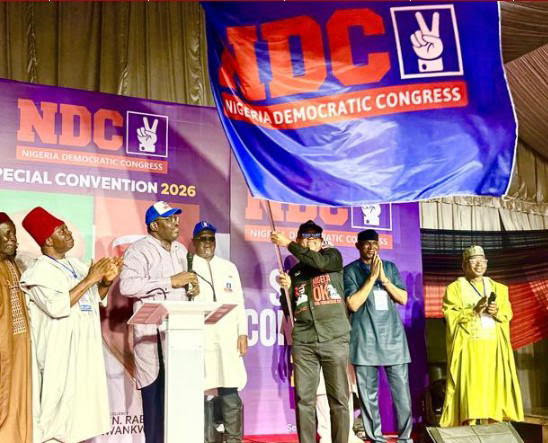
Abuja, May 30, 2026 — The presidential candidate of the Nigeria Democratic Congress (NDC), Peter Obi, has formally accepted his nomination, delivering a wide-ranging address that outlined his vision for national unity, security, economic recovery, healthcare reform, agricultural transformation, educational advancement, and democratic renewal.
Speaking before party leaders, delegates, supporters, and stakeholders gathered in Abuja, Obi described his emergence as the party’s standard-bearer as a responsibility rooted in service rather than personal ambition. He expressed gratitude to party leaders, members of the National Working Committee, supporters across the country, and Nigerians who continue to believe in the possibility of a better future.
At the heart of his speech was a message that has become synonymous with his political movement: “A New Nigeria is Possible.” According to Obi, the 2027 presidential contest is not about an individual but about rebuilding a nation that has suffered from years of insecurity, economic hardship, declining public services, and widespread loss of confidence in governance.
Call for National Unity;
Obi emphasized that Nigeria’s recovery must begin with national unity. He warned against the dangers of ethnic, religious, regional, and political divisions, arguing that the country’s diversity should be a source of strength rather than conflict.
He called on Nigerians to replace mistrust with cooperation, division with understanding, and resentment with a shared national purpose. Quoting historian Will Durant, Obi noted that civilizations often collapse from internal divisions before external threats can destroy them.
The NDC candidate maintained that national healing and unity would form the foundation of his administration’s governance agenda.
Tackling Insecurity Through Intelligence and Technology;
Addressing one of Nigeria’s most pressing challenges, Obi described the country’s worsening security situation as unacceptable and pledged decisive action to restore safety across the federation.
He highlighted Nigeria’s distinguished record in international peacekeeping operations, noting the country’s contributions to missions in countries such as Rwanda, Liberia, Sierra Leone, Sudan, Mali, Lebanon, Haiti, Cambodia, Congo, and Kuwait.
Obi argued that a nation once respected globally for security leadership should not be overwhelmed by internal insecurity.
He promised an intelligence-driven, technology-based, proactive, and community-centered security architecture that would strengthen coordination among security agencies, improve support for personnel, and address the root causes of violence, including poverty, unemployment, and social exclusion.
According to him, farmers must be able to return to their fields, students must learn without fear, and investors must regain confidence in Nigeria’s security environment.
Healthcare Reform and Universal Access;
A significant portion of the speech focused on healthcare.
Obi lamented Nigeria’s poor healthcare rankings and the deteriorating condition of primary healthcare facilities across the country. He noted that only a fraction of the nation’s approximately 30,000 primary healthcare centers are fully operational.
To reverse this trend, he pledged to increase health insurance coverage from current levels to more than double within four years. He also promised to raise healthcare spending to at least 10 percent of GDP and invest heavily in medical infrastructure, healthcare personnel training, and staffing.
One of the most ambitious healthcare promises announced was the commitment to establish fully functional primary healthcare centers in all 8,809 wards nationwide while ensuring that at least half of Nigeria’s existing primary healthcare facilities become fully operational before the end of his first term.
Education as the Engine of National Development
Obi described education as the most important tool for national transformation.
He argued that no nation can rise above the quality of its educational system and stressed the need for sustained investment in schools, teachers, technology, innovation, and vocational training.
According to him, Nigeria must shift from producing job seekers to producing job creators. He maintained that strategic investments in human capital would move the country from widespread poverty to shared prosperity.
The NDC candidate promised that education would remain at the center of his development agenda if elected president.
Agriculture and the Fight Against Hunger
One of the strongest sections of the speech focused on food security and agricultural production.
Obi expressed concern over Nigeria’s worsening position among the world’s most food-insecure countries despite possessing vast arable land and favorable agricultural conditions.
Drawing comparisons with major rice-producing nations such as India, Bangladesh, and Vietnam, he argued that Nigeria has no justification for remaining among countries facing severe food shortages.
He maintained that the nation’s future prosperity depends on transforming agriculture into a productive and industrialized sector.
According to Obi, large portions of uncultivated land, particularly in northern Nigeria, represent one of the country’s greatest economic assets and should be harnessed to drive food production, employment creation, export growth, and poverty reduction.
Power Sector Expansion
On energy, Obi described Nigeria’s electricity deficit as a major obstacle to economic growth and industrial development.
He noted that Nigeria currently generates and distributes far less electricity than comparable economies despite having a significantly larger population.
To address the challenge, he committed to delivering an additional 10,000 megawatts of electricity generation and distribution capacity within four years.
The promise, he said, would support industrialization, attract investment, reduce business costs, and stimulate economic expansion across the country.
Jobs, MSMEs, and Economic Growth
Recognizing unemployment and underemployment as major threats to social stability, Obi pledged aggressive support for Micro, Small, and Medium Enterprises (MSMEs).
He argued that official unemployment figures fail to reflect the true extent of joblessness and economic hardship among Nigerian youths.
His proposed strategy includes tax incentives, affordable financing, special lending arrangements, and targeted support for key sectors such as agriculture, manufacturing, entertainment, sports, and distribution.
Obi stated that economic growth must be measurable and directly beneficial to ordinary Nigerians.
Anti-Corruption and Cost of Governance
The NDC presidential candidate also pledged a significant reduction in corruption and government waste.
He promised transparent management of public resources and insisted that every naira spent by government must produce measurable value for citizens.
According to him, accountability, prudence, and transparency would become defining principles of his administration.
Commitment to Rule of Law and Democratic Values
On governance, Obi vowed to uphold the rule of law without exception and ensure strict compliance with constitutional provisions by both public officials and citizens.
He further promised to strengthen democratic institutions and promote a political culture that respects opposition parties and encourages constructive engagement.
En what appeared to be a criticism of growing concerns about democratic backsliding, Obi pledged that under his leadership, governance would be characterized by fairness, transparency, integrity, and respect for democratic norms.
A Defining Moment for the Opposition
Political observers view Obi’s acceptance speech as a formal launch of what is expected to become one of the most consequential opposition campaigns ahead of the 2027 general elections.
The address sought to present a comprehensive governance blueprint centered on production, accountability, security, healthcare, education, agriculture, energy expansion, and national unity.
As the NDC begins preparations for the next phase of its national campaign, Obi’s message was clear: Nigeria’s challenges are significant, but they are not insurmountable.
Ending his speech on a note of optimism, the NDC flag bearer reiterated the declaration that has become the rallying cry of his supporters across the country:
“A New Nigeria is Possible.”


