

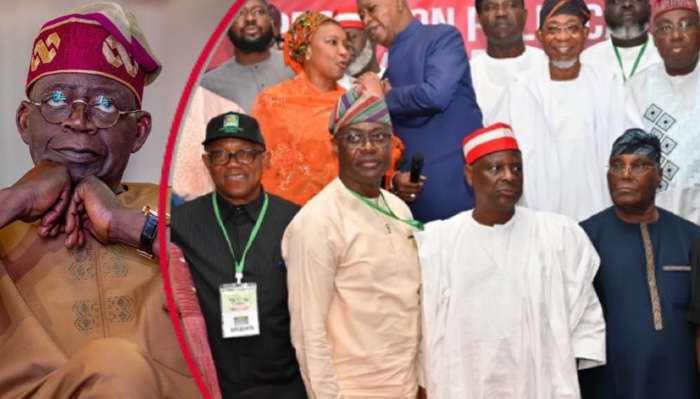
Nigeria’s opposition political landscape witnessed a significant development over the weekend as key leaders from major parties converged in Ibadan and agreed in principle to field a single presidential candidate for the 2027 general elections.
The high-level meeting, hosted by Seyi Makinde, brought together prominent figures from the African Democratic Congress (ADC) and the Peoples Democratic Party (PDP), among other opposition blocs. At the end of deliberations, participants issued what has now been termed the “Ibadan Declaration,” signaling a coordinated effort to present a united front against the ruling party in the next election cycle.
The declaration underscores a growing recognition among opposition leaders that fragmentation has historically weakened their chances in national elections. By rallying behind a single candidate, stakeholders aim to consolidate votes across regions and demographics, thereby increasing their competitiveness against the incumbent All Progressives Congress (APC).
Emerging from the discussions, former presidential candidate Peter Obi is widely seen as a leading contender for the unified ticket. Obi’s supporters point to his cross-regional appeal, particularly among young voters, as well as his performance in the 2023 elections, where he secured millions of votes and disrupted traditional political patterns.
However, the path to consensus remains complex. Loyalists of Atiku Abubakar have continued to advocate for his candidacy, citing his experience and longstanding political network. Some within the coalition have also floated the idea of a joint ticket arrangement, potentially combining the strengths of multiple candidates.
Despite these underlying tensions, both Obi and Atiku are reported to have pledged their commitment to a fair and transparent primary process. They have also assured supporters that whoever emerges as the consensus candidate will receive unified backing from the coalition.
Political analysts describe the Ibadan summit as a pivotal moment in Nigeria’s pre-2027 political realignments. While the agreement to pursue a single candidate marks a significant step, they caution that sustaining unity will require careful negotiation, mutual trust, and clear power-sharing arrangements.
“Coalition-building in Nigeria is often easier at the declaration stage than in implementation,” one analyst observed. “The real challenge will be managing ambitions and preventing defections as the process unfolds.”
Indeed, concerns about potential fractures remain. Reports of internal rivalries and the possibility of defections continue to cast a shadow over the emerging alliance. Maintaining cohesion among diverse political interests will be critical to the coalition’s success.
As the ADC prepares for its upcoming convention, attention is expected to shift toward the mechanics of selecting the unified candidate. The credibility of the process will likely play a decisive role in determining whether the coalition can maintain its momentum.
For many observers, the Ibadan Declaration represents both an opportunity and a test—an opportunity for the opposition to reshape Nigeria’s political dynamics, and a test of its ability to rise above internal divisions.
With the 2027 elections still months away, the coming period will reveal whether this newfound unity can endure or whether familiar patterns of fragmentation will re-emerge. Either way, the Ibadan summit has set the stage for what promises to be a highly competitive and closely watched electoral contest.


