
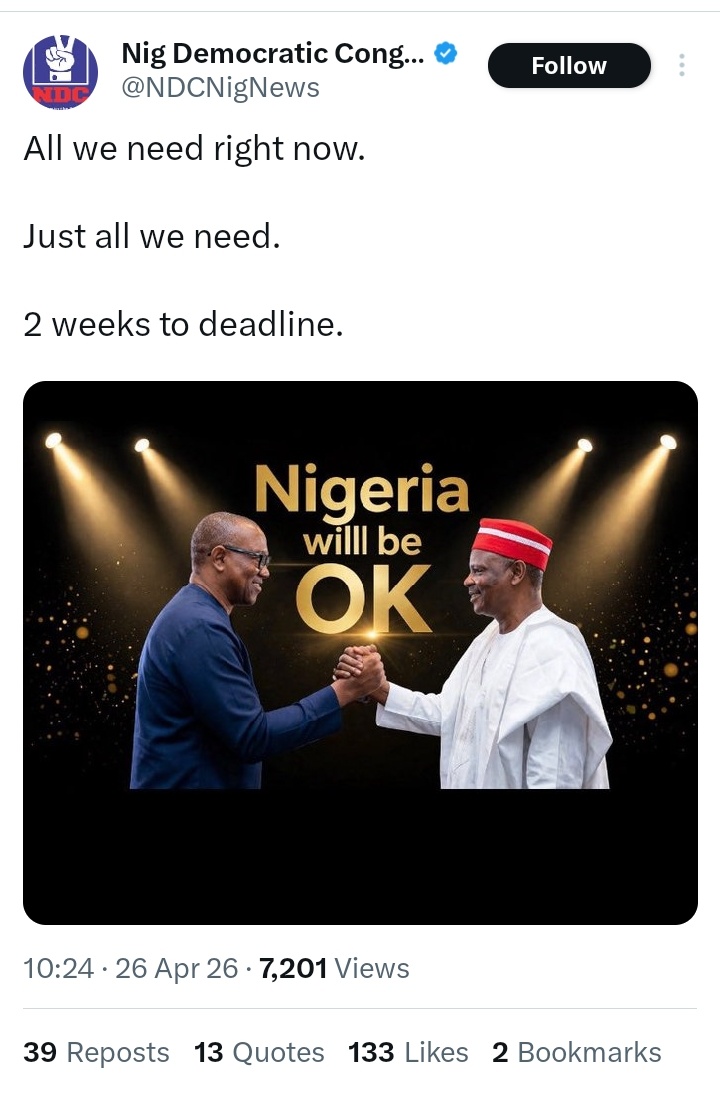
The endorsement of the OK Ticket by the NDC through its official X handle, @NDCNigNews, marks a significant political development in the growing coalition efforts ahead of the 2027 general elections.
The public declaration is being interpreted as more than just a routine endorsement. It reflects the increasing confidence among opposition stakeholders that the OK Ticket has the capacity to serve as a rallying point for Nigerians seeking an alternative to the current political order. By choosing to openly back the ticket, the NDC is signaling its belief that the alliance offers a credible pathway toward national recovery, institutional reforms, and stronger democratic governance.
Political analysts note that endorsements from organized democratic movements such as the NDC carry strategic importance because they often influence grassroots mobilization, civic engagement, and broader coalition-building. Such support can help shape public perception and strengthen legitimacy, especially when the country is witnessing rising demands for accountability, economic reforms, and inclusive leadership.
The NDC’s statement reportedly emphasized that the decision was driven by national interest rather than personal ambition or sectional politics. According to the coalition, Nigeria requires leaders with proven competence, integrity, and the ability to unite diverse political interests for the common good. The OK Ticket, they argued, represents this possibility.
This endorsement also signals a major caveat for the broader opposition coalition, particularly around the growing momentum for a Peter Obi and Rabiu Musa Kwankwaso ticket, which has reportedly caught fire across the country like wildfire. Supporters of the Obi-Kwankwaso alliance believe such a ticket represents one of the strongest combinations capable of galvanizing youth voters, northern and southern political interests, and the wider reform-minded electorate.
With the NDC openly backing the OK Ticket, it introduces a fresh layer of strategic calculation within the opposition camp. It raises important questions about whether opposition forces will consolidate around a single consensus candidate or continue to witness competing endorsements that may weaken collective strength ahead of 2027.
This endorsement also comes at a time when opposition forces are intensifying consultations across major political blocs, including youth movements, civil society groups, and regional stakeholders. The objective is to avoid fragmentation and present a single formidable presidential candidate capable of challenging the ruling establishment in 2027.
Supporters of the endorsement see it as a timely boost that could encourage other coalition partners to publicly align with the same vision. They argue that a united opposition front remains the strongest strategy for democratic transition and electoral success.
However, critics maintain that endorsements alone are not enough without clear structures, policy direction, and internal party discipline. They insist that the success of any coalition will depend on transparency, fairness, and the ability to manage competing ambitions among political actors.
Nonetheless, the NDC’s backing of the OK Ticket has added fresh momentum to the national conversation, reinforcing the idea that the 2027 elections may be shaped largely by coalition politics, strategic alliances, and the search for a consensus candidate capable of inspiring national confidence.
NDC Endorses OK Ticket as Obi-Kwankwaso Coalition Momentum Sparks 2027 Opposition Power Battle

- Advertisement -

