
Former President Olusegun Obasanjo has delivered a sharp criticism of President Bola Ahmed Tinubu’s handling of regional diplomacy, warning that Nigeria’s influence in West Africa has significantly declined under the current administration.
Speaking on the state of regional affairs, Obasanjo lamented that Nigeria, once regarded as the dominant voice in West African politics and diplomacy, is no longer playing a leading role in critical continental decisions.
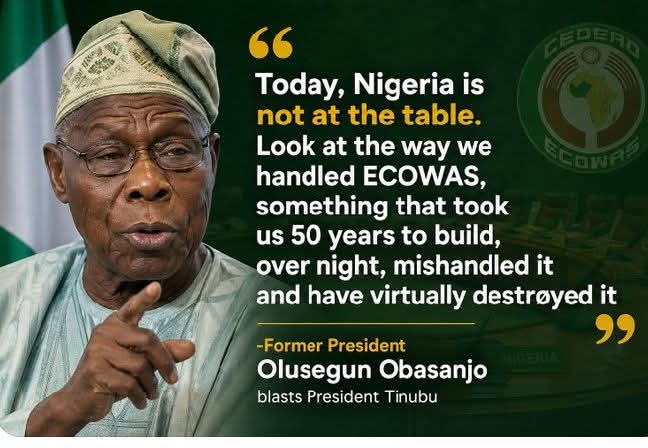
“Today, Nigeria is not at the table. Look at the way we handled ECOWAS, something that took us 50 years to build, overnight, mishandled it and have virtually destroyed it,” the former president stated.
His remarks were seen as a direct attack on the Tinubu administration’s management of the Economic Community of West African States (ECOWAS), particularly in relation to recent tensions involving Niger, Mali, and Burkina Faso, as well as the broader instability within the sub-region.
Obasanjo suggested that Nigeria’s diplomatic missteps have weakened the country’s long-standing leadership position and undermined decades of regional institution-building. He stressed that ECOWAS was not built overnight, but through years of sacrifice, negotiation, and strategic leadership by successive administrations.
Political observers say the former president’s statement reflects growing concern among elder statesmen over Nigeria’s foreign policy direction and the country’s diminishing influence in African affairs.
The criticism also comes amid broader national debates over governance, economic hardship, and Nigeria’s international standing under President Tinubu’s leadership.
While the presidency has yet to officially respond to Obasanjo’s comments, the statement has already generated strong reactions across political and diplomatic circles, with many Nigerians debating whether the country’s regional leadership has indeed been weakened.
For many, Obasanjo’s warning serves as a reminder that Nigeria’s strength on the African stage depends not only on economic power but also on strategic diplomacy, credible leadership, and responsible engagement with neighboring nations.
Olusegun Obasanjo to Bola Ahmed Tinubu: You Have Weakened Nigeria, Destroyed ECOWAS

- Advertisement -

