

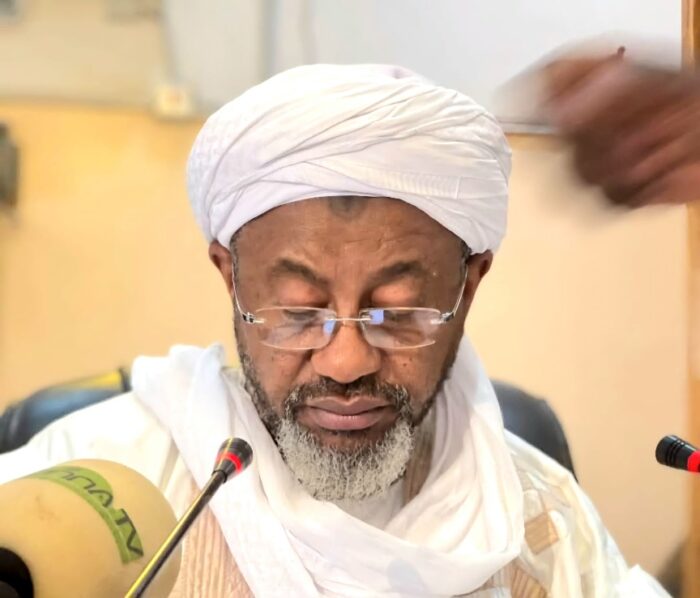
The renewed call by the Supreme Council for Shari’ah in Nigeria (SCSN) for the removal of the INEC Chairman ahead of the 2027 general elections raises serious concerns—not just about electoral administration, but about the growing tendency to weaponise faith and identity to pre-emptively delegitimise democratic institutions.
At the heart of the Council’s argument is an alleged legal brief attributed to the INEC Chairman, said to have referenced claims of a “Christian genocide” in Nigeria. Even if such a brief exists—and that remains a matter for verification and legal context—it is deeply problematic to reduce a public official’s entire integrity to a single legal argument made outside the conduct of his statutory duties. Legal briefs, by their nature, are advocacy documents, often crafted within specific judicial contexts, and do not automatically translate into policy positions or administrative bias.
More troubling is the precedent being set. Calling on an entire religious community to reject future elections unless a named official is removed is not a neutral demand for accountability; it is a threat to the democratic order. Nigeria’s constitution does not vest any religious body—Christian or Muslim—with veto power over electoral umpires. INEC’s credibility rests on law, procedure, transparency, and judicial oversight, not on sectarian approval.
If integrity concerns exist, the proper democratic channels are clear: petitions backed by evidence, judicial review, and constitutional processes. What weakens democracy is not disagreement with an official, but the substitution of due process with mass delegitimisation rhetoric. History has shown, in Nigeria and elsewhere, that once elections are framed as religiously illegitimate before they even occur, violence and instability are never far behind.
It is also important to note the asymmetry in the argument. The Federal Government has repeatedly denied the existence of any state-sanctioned religious genocide in Nigeria, yet insecurity has undeniably devastated communities across faith lines. Villages—Muslim and Christian alike—have been wiped out by bandits, terrorists, and criminal gangs. To frame the discussion as a competition of victimhood, rather than a shared national tragedy rooted in state failure, is to miss the point and inflame tensions.
INEC, like all public institutions, must be scrutinised. But scrutiny must be evidence-based, non-sectarian, and anchored in the law. The moment religious bodies begin to declare elections illegitimate in advance, democracy itself becomes the casualty. Nigeria cannot afford a future where electoral outcomes are accepted or rejected based on faith allegiance rather than ballots, courts, and institutions.
As 2027 approaches, restraint, responsibility, and respect for constitutional order are urgently needed—from INEC, from government, and equally from influential religious and civic organisations. Democratic credibility is not protected by threats of boycott; it is protected by transparency, accountability, and collective commitment to a shared national future.
Framing the demand for the removal of the INEC Chairman as an urgent national issue is a misplaced priority for several fundamental reasons, especially given Nigeria’s current realities.
First, Nigeria is facing an existential security and humanitarian crisis. Tens of thousands have been killed, millions displaced, and entire communities—across Muslim and Christian regions alike—have been overrun by bandits, terrorists, and criminal gangs. Schools are closed, farmlands abandoned, and local economies destroyed. In this context, elevating a pre-election personality dispute above the daily survival of citizens reflects a profound disconnect from the lived realities of ordinary Nigerians. If religious leadership is to speak with moral urgency, the collapse of security and the protection of innocent lives should logically rank far higher.
Second, the focus on an alleged legal brief, rather than on the actual conduct of INEC in administering elections, shifts attention away from substantive democratic reforms. Nigeria’s electoral problems are structural: weak enforcement of electoral offences, vote buying, logistical failures, abuse of state power, and poor prosecution of violators. None of these are resolved by removing one individual based on past legal opinions unrelated to election administration. Priorities should be centred on institutional reform, not symbolic scapegoating.
Third, the demand undermines constitutional order. INEC’s independence is deliberately insulated from pressure by interest groups—religious, ethnic, or political—precisely to prevent capture. When a religious body positions itself as the arbiter of who is fit to conduct elections, it shifts the national conversation away from rule of law to sectarian leverage. That is not democratic vigilance; it is a dangerous distortion of civic responsibility.
Fourth, the threat that “Muslims will not recognise” elections under a named official is itself destabilising. Democracy depends on acceptance of outcomes through legal channels, not pre-emptive rejection. Encouraging mass non-recognition before any wrongdoing has occurred prioritises mobilising grievance over safeguarding peace. In a fragile polity like Nigeria, such rhetoric risks triggering unrest far more damaging than any hypothetical bias.
Finally, the emphasis on identity politics distracts from shared national accountability. Insecurity, poverty, unemployment, and state failure do not discriminate by faith. When leadership discourse narrows national problems to religious narratives, it weakens collective pressure on government to deliver results. The real priority should be demanding competence, transparency, and justice from all institutions—executive, legislative, security, and electoral—without turning democracy into a battlefield of religious suspicion.
In essence, this controversy elevates who is in charge over how institutions function, why citizens are suffering, and what reforms are urgently needed. That inversion of priorities does not strengthen democracy; it diverts attention from the hard work of fixing Nigeria’s broken systems.


