

Fresh concerns have emerged over what many stakeholders describe as deliberate judicial delay capable of destabilizing the opposition coalition and frustrating the African Democratic Congress (ADC) ahead of the 2027 general elections.
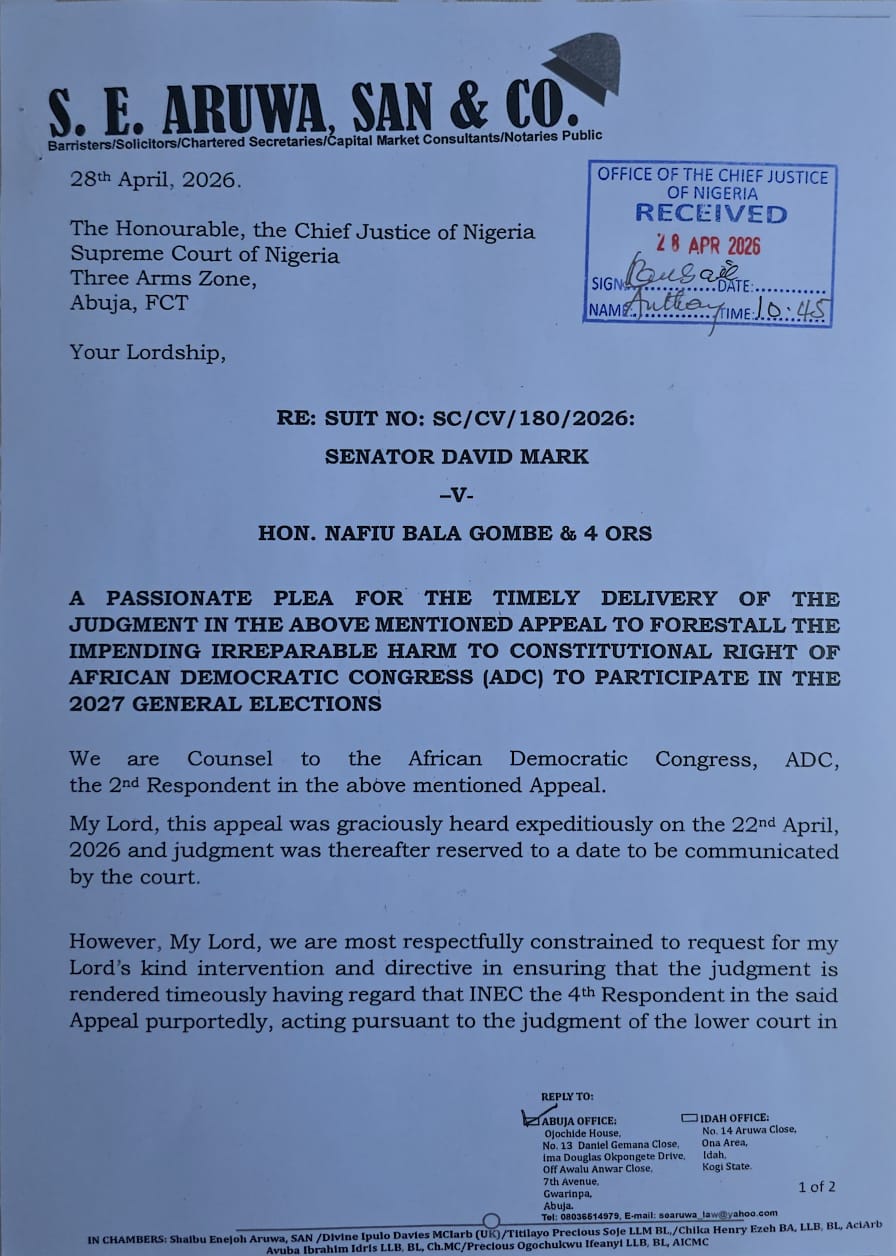
Documents now before the public reveal that the legal team representing ADC, led by Senior Advocate of Nigeria, Shaibu Enejo Aruwa, SAN, has formally written to the Chief Justice of Nigeria, making a passionate plea for the timely delivery of judgment in Suit No. SC/CV/180/2026 involving Senator David Mark versus Hon. Nafiu Bala Gombe & 4 Others.
The appeal, which was heard and reserved for judgment on April 22, 2026, directly affects the leadership recognition of the ADC and its constitutional right to fully participate in the 2027 general elections.
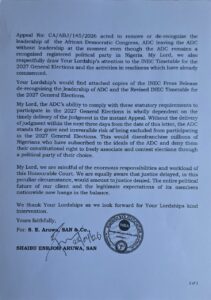
According to the letter received by the Office of the Chief Justice of Nigeria on April 28, ADC warned that INEC had already acted based on the lower court judgment by allegedly moving to de-recognize the party’s leadership structure, leaving the party in a dangerous state of uncertainty despite remaining a legally registered political party.
The legal team stressed that ADC’s ability to comply with statutory requirements for the 2027 elections is wholly dependent on the immediate delivery of the Supreme Court judgment.
They warned that failure to deliver judgment within days could expose the party to grave and irreversible consequences, including possible exclusion from the 2027 elections and the disenfranchisement of millions of Nigerians who identify with the party.
However, strong political concerns are now being raised as indications suggest the court may delay judgment until May 5.
Analysts warn that such timing dangerously narrows the window for realistic political decision-making.
Should the Supreme Court eventually direct the matter back to the High Court, the opposition would be left with only three working days—May 6, 7, and 8—to take critical legal and political decisions before the INEC submission deadline, while May 9 and 10 fall on the weekend and effectively close the window.
This development has triggered accusations that the court may be dancing to the dictates of the ruling establishment by strategically compressing time against the opposition and weakening its ability to organize effectively.
Critics argue that justice delayed in this circumstance may amount to justice denied, particularly when the delay threatens not just party leadership but the broader constitutional right of political participation.
Many within the opposition believe this is part of a larger pattern aimed at destabilizing alternative political platforms and consolidating one-party dominance ahead of 2027.
The fear is no longer just about legal procedure, but about whether democratic institutions are being manipulated to frustrate opposition voices and deny Nigerians genuine electoral choices.
With the clock ticking and the nation watching, the judiciary now faces a critical test of independence, fairness, and constitutional responsibility.
For many Nigerians, the question remains whether justice will be delivered in time—or whether delay itself has become the strategy.


