

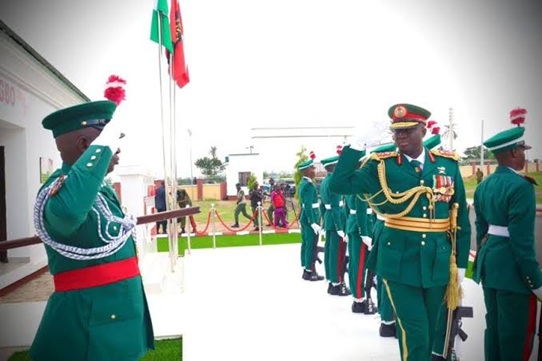
The Nigerian Army has deployed 87 newly trained soldiers to various theatres of Operation FANSAN YAMMA as part of efforts to strengthen ongoing operations against security threats in the country.
The soldiers, members of the 90 Regular Intake, recently completed an eight-week intensive military training programme at the 1 Division Training School, Dalet Barracks, Kawo, Kaduna. They graduated after successfully completing Exercise Shining Star X/26.
The graduation ceremony was held on Friday and was attended by senior military officers, instructors, family members and other guests. The General Officer Commanding 1 Division Nigerian Army and Commander, Sector 1, Operation FANSAN YAMMA, Major General Abubakar Sadique Muhammad Wase, was represented at the event by the Chief of Staff, 1 Division, Brigadier General TM Opurum.
In his address, Opurum said the training was approved by the Chief of Army Staff, Lieutenant General Waidi Shaibu, to strengthen Army formations and improve the operational readiness of personnel.
He explained that the programme was designed to build resilience, teamwork, discipline and professionalism among the soldiers while preparing them for the security challenges confronting the country.
During the eight-week exercise, the trainees participated in several military activities, including field operations, live-fire drills, battle inoculation, land navigation and watermanship.
They were also trained in tactical motorcycle operations and Improvised Explosive Device awareness, among other specialised exercises.
According to the Army, the training was structured to prepare the soldiers for the operational demands within the 1 Division’s Area of Responsibility and the wider responsibilities they would face during deployment.
The soldiers were also subjected to simulated combat conditions intended to test their endurance, mental alertness and ability to work effectively as a team.
The exercises reportedly included scenarios involving combat fatigue, stress and sleep deprivation, designed to expose the trainees to conditions they could encounter during actual military operations.
Opurum urged the graduating soldiers to apply the knowledge and skills acquired during the training as they take up their new responsibilities.
He reminded them of the importance of discipline, loyalty and professionalism, while directing them to comply strictly with the Nigerian Army’s code of conduct and rules of engagement.
Earlier, the Acting Assistant Director, Army Physical Training and Divisional Training Officer, Lieutenant Colonel Pharouk Mohammed, said the trainees had undergone intensive tactical, weapon-handling and counter-terrorism training.
Mohammed said the 87 soldiers had met the required standards in both character and military training and were considered ready to discharge their constitutional responsibilities.
The training also featured practical demonstrations designed to test the soldiers’ proficiency. These included a rapid rifle stripping and assembly competition and a counter-ambush display.
The demonstrations provided an opportunity for the trainees to showcase some of the skills they acquired during the programme before their deployment.
Speaking on behalf of the graduating soldiers, the Course Leader, Private Kapnim Bitrus, expressed appreciation to the military authorities and instructors for their guidance throughout the training.
The ceremony concluded with the presentation of certificates to the newly trained soldiers, followed by a group photograph.
The deployment comes as Nigerian security forces continue operations against terrorism, banditry, kidnapping and other forms of insecurity across different parts of the country.
Operation FANSAN YAMMA is among the military operations being used to address security threats, particularly in areas within the North-West and other parts of the country’s security theatre.
With their newly acquired tactical and counter-terrorism skills, the 87 soldiers are expected to reinforce existing troops and contribute to ongoing operations.
Their deployment also reflects the Army’s continued emphasis on specialised training and operational preparedness as it responds to evolving security challenges across Nigeria.


