

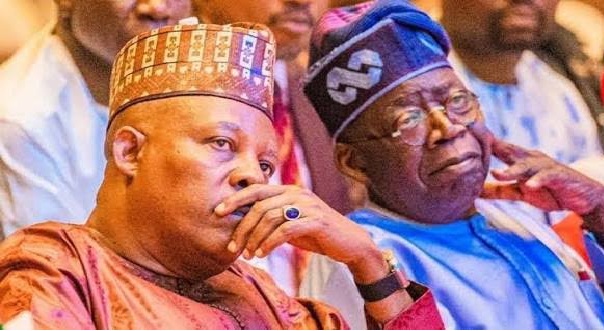
President Bola Ahmed Tinubu’s extended stay outside Nigeria has triggered renewed debate over the constitutional procedure governing presidential absence and the transfer of executive powers to the Vice President.
Tinubu left Nigeria on August 30 for what the Presidency described as a three-week working vacation. On September 21, the Presidency announced that the President had extended his stay abroad by a few days, saying he would return to Nigeria at the weekend.
The development has drawn attention to Section 145 of the 1999 Constitution, which deals with situations where the President proceeds on vacation or is otherwise unable to discharge the functions of his office.
Section 145(1) provides that the President “shall” transmit a written declaration to the President of the Senate and the Speaker of the House of Representatives whenever he proceeds on vacation or is otherwise unable to perform the functions of his office. The provision further states that, until a declaration to the contrary is transmitted, the Vice President performs the functions of the President as Acting President.
However, the interpretation of the provision, particularly its reference to 21 days, has become a point of disagreement among lawyers and political actors.
Section 145(2) provides that if the President is unable or fails to transmit the required declaration within 21 days, the National Assembly may, by a simple majority in both chambers, mandate the Vice President to perform the functions of the President as Acting President.
Some constitutional commentators have interpreted the provision as meaning that the National Assembly’s intervention becomes relevant once the 21-day period has elapsed. Others argue that the first subsection creates an immediate obligation on a President who proceeds on vacation to notify the National Assembly, regardless of how long the absence is expected to last.
The controversy intensified after Vice President Kashim Shettima travelled to New York on September 20 to represent Nigeria at the 81st United Nations General Assembly, while Tinubu remained in Europe. The simultaneous absence of the President and Vice President prompted questions from opposition politicians and some legal practitioners about the continuity of presidential authority.
Human rights lawyer Inibehe Effiong argued that Section 145 requires a formal arrangement for the exercise of presidential powers when the President is on vacation. He described the simultaneous absence of Tinubu and Shettima as a constitutional concern and called on the National Assembly to address the matter. His position is a legal interpretation and has not been established as a judicial determination.
The African Democratic Congress has also questioned whether Tinubu transmitted the required written declaration to the National Assembly. The party’s position was that clarification was needed concerning the constitutional status of presidential powers during the President’s prolonged absence.
The Presidency, however, has maintained that there is no leadership vacuum. Senate President Godswill Akpabio said Tinubu remained in charge and continued to direct government affairs from abroad. Akpabio also rejected suggestions that he had become Acting President.
The Presidency similarly stated that Tinubu had remained in contact with officials in Nigeria and continued directing government business during his working vacation. It said Vice President Shettima had been delegated to represent the President at certain official engagements, including the United Nations General Assembly.
Earlier legal analysis has also highlighted the uncertainty surrounding the relationship between Sections 145(1) and 145(2). While one interpretation treats the written declaration as an immediate constitutional requirement, another views the 21-day provision as significant to determining when the National Assembly can intervene if no declaration has been transmitted.
As the debate continues, the central unresolved question is whether the President formally transmitted a Section 145 declaration to the National Assembly and, if so, what constitutional effect it had on the exercise of presidential functions during his absence.
The controversy has added another issue to the political discussions ahead of the 2027 general elections, with opposition figures demanding greater transparency while government officials maintain that the President has continued to exercise his constitutional responsibilities.


