

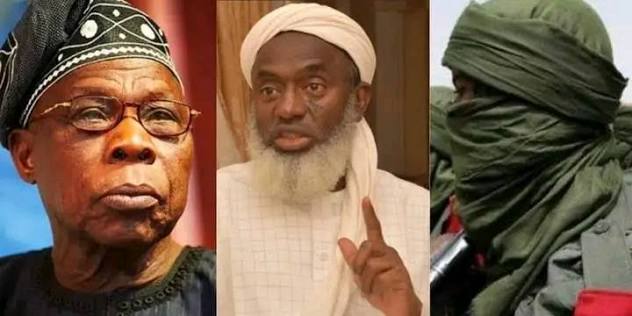
Islamic scholar Sheikh Ahmad Gumi has claimed that former President Olusegun Obasanjo once held discussions with leaders of Boko Haram in an effort to end the insurgency through dialogue.
Gumi alleged that the meeting produced an understanding under which members of the terrorist group were prepared to surrender their weapons and abandon violence, but said the agreement was ultimately frustrated by the government.
The cleric made the claim while discussing Nigeria’s long-running security challenges and the various attempts by successive administrations to resolve insurgency through military operations, negotiations and other interventions.
According to Gumi, the engagement with Boko Haram leaders demonstrated that dialogue could provide an alternative route to ending violent conflicts.
He, however, alleged that the government failed to follow through on the understanding reached during the discussions, leading to the continuation of the conflict.
The claim is significant because Boko Haram’s insurgency has remained one of Nigeria’s most serious security challenges since the group intensified its violent campaign in the late 2000s. The conflict has resulted in thousands of deaths, mass displacement and repeated attacks on communities and security installations.
Gumi has previously advocated negotiation and dialogue as part of efforts to resolve insecurity in northern Nigeria. Academic research into his mediation activities has documented his involvement in negotiations concerning kidnappers and abducted students, including efforts linked to the release of 27 students abducted from the Federal College of Forestry Mechanisation in Kaduna in 2021.
His latest comments have therefore reopened debate over whether negotiations with armed groups can complement military measures in addressing Nigeria’s security problems.
However, Gumi’s account of the alleged Obasanjo-Boko Haram meeting and the reported agreement has not been independently established by the sources reviewed for this report. No response from Obasanjo or the Federal Government was immediately available regarding the specific claim.
Obasanjo served as Nigeria’s president from 1999 to 2007. Boko Haram emerged as a major security threat during the years that followed, particularly after the death of its founder, Mohammed Yusuf, in 2009.


