

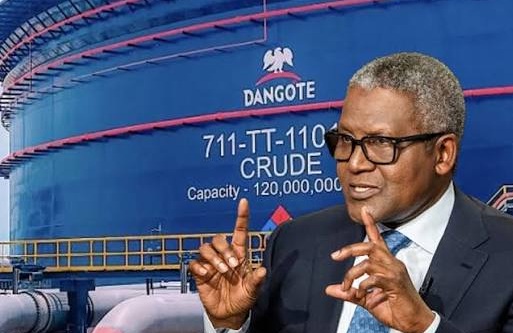
The Dangote Petroleum Refinery has warned that it may divert surplus petrol to international markets as rising imports create uncertainty over domestic demand and complicate its ability to plan production and manage inventories.
The refinery said imported Premium Motor Spirit, commonly known as petrol, accounted for about 43 per cent of the fuel supplied into Nigeria in July, despite the refinery’s capacity to meet and exceed the country’s domestic requirements.
According to the refinery, the continued issuance of licences for petroleum product imports has made it increasingly difficult to predict how much petrol will be required from local producers.
The uncertainty, it said, has resulted in growing inventories that cannot always be absorbed by the domestic market. Rather than allow excess products to remain in storage and incur additional financing and storage costs, the refinery said it would increasingly consider exporting the surplus to regional and international markets.
The development marks another major twist in Nigeria’s attempt to reduce its dependence on imported refined petroleum products.
The Dangote Refinery, located in Lekki, Lagos, was established with the capacity to transform Nigeria from a major importer of refined petroleum products into a potential exporter. Its growing output has already contributed significantly to Nigeria’s emergence as a regional supplier of refined petroleum products.
Recent data from the United States Energy Information Administration showed that Nigeria’s seaborne petroleum product shipments averaged 561,000 barrels per day in the second quarter of 2026, while exports averaged about 350,000 barrels per day. The EIA attributed much of the increase to the expansion of production at the Dangote Refinery.
However, the refinery now faces a different challenge: increased competition from imported petrol in the domestic market.
Dangote argued that its decision to increase exports should not be interpreted as an inability to meet Nigerian demand. Instead, it said exports were becoming necessary because imported products were creating excess inventories and making domestic demand difficult to forecast.
The refinery warned that if excessive imports continue to distort the market, any future shortage caused by local refiners being unable to accurately plan production should not be blamed on Dangote.
It called for greater transparency in the issuance of import licences and improved coordination within the downstream petroleum sector.
The company also urged the government to adopt policies that encourage domestic refining, strengthen Nigeria’s energy security, conserve foreign exchange and maximise the economic benefits of investments in local refining capacity.
The controversy comes against the backdrop of Nigeria’s long-standing struggle to become self-sufficient in refined petroleum products. For decades, the country exported crude oil while importing much of the petrol consumed by its citizens, placing pressure on foreign exchange reserves and exposing consumers to international market fluctuations.
The Dangote Refinery was expected to reverse that pattern by supplying the domestic market while creating an export surplus.
However, the current situation demonstrates the complexity of transitioning from an import-dependent petroleum market to one dominated by domestic refining. While local production capacity has increased substantially, marketers continue to have access to imported products, creating competition between locally refined and imported petrol.
The development could also have implications for fuel prices and supply stability. If significant quantities of Dangote’s petrol are redirected abroad while imports continue, Nigeria could find itself in the unusual position of simultaneously exporting locally refined petrol and importing competing supplies.
For the Dangote Refinery, the priority is maintaining commercially sustainable operations and avoiding unnecessary inventory accumulation.
For policymakers, the challenge is determining how to balance market competition with the government’s broader objective of supporting domestic refining and reducing dependence on imported fuel.
The latest warning therefore places renewed pressure on regulators to clarify Nigeria’s petroleum import policy and provide greater certainty for refiners and marketers.
As the downstream sector continues to evolve, the central question is whether Nigeria can create a market structure that allows domestic refineries to operate at optimal capacity while ensuring reliable and affordable fuel supplies for consumers.
The Dangote Refinery’s threat to export excess petrol is a powerful indication that Nigeria’s fuel challenge is no longer simply about producing enough petrol. It is increasingly about creating a predictable and competitive market capable of absorbing what the country produces.


