

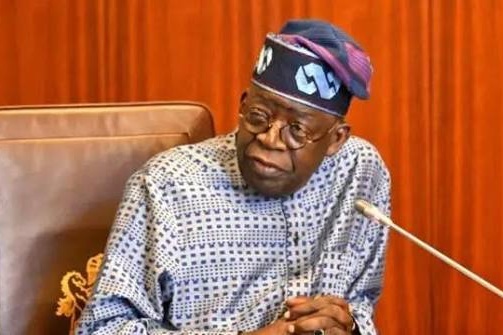
President Bola Ahmed Tinubu has described the Hausa people as “great pillars” of Nigeria’s unity and progress, while highlighting the growing importance of the Hausa language as a bridge for communication, commerce and cultural interaction.
Tinubu made the remarks on Wednesday in a message marking Hausa Day, being celebrated at the historic Daura Palace in Katsina State. He congratulated the Hausa community and praised its contribution to Nigeria’s national identity.
“The Hausa people are great pillars that play a vital role in the unity and progress of Nigeria,” the President said.
He also described Hausa as a language that has expanded beyond its traditional geographical boundaries, becoming an important means of communication and commerce across Nigeria and beyond.
According to the President, the continued spread of the language demonstrates its significance in connecting people and communities across cultural and geographical lines.
“I congratulate the vast Hausa community on the occasion of Hausa Day, which is being celebrated at the historic Daura Palace today,” Tinubu said.
The President’s message comes at a time when questions of ethnic identity, national cohesion and peaceful coexistence remain prominent in Nigeria’s public discourse.
Nigeria is home to hundreds of ethnic and linguistic groups, making national unity a continuing political and social priority. Hausa, alongside other major Nigerian languages, has historically played an important role in communication across northern Nigeria and in commercial interactions extending beyond the country’s borders.
Tinubu’s recognition of the Hausa community also places emphasis on the role of cultural heritage in strengthening national identity.
Rather than presenting cultural diversity as a source of division, the President’s message sought to frame it as an asset that can contribute to a more cohesive Nigeria.
The celebration at Daura Palace provides a symbolic setting for the occasion. Daura, in Katsina State, is one of the historic centres associated with Hausa culture and traditional institutions.
The President’s comments also come against the backdrop of continuing security and political challenges confronting the country. In recent months, Tinubu has repeatedly called for greater unity and cooperation among Nigerians as the government confronts insecurity and seeks to strengthen national development.
The emphasis on unity is particularly significant as Nigeria moves towards the 2027 general elections, when ethnic, regional and religious considerations are expected to remain important factors in political mobilisation.
Political leaders and civil society groups have increasingly called for campaigns to focus on national issues rather than ethnic or religious divisions.
Tinubu himself has previously urged Nigerians to reject forces seeking to undermine the country’s unity and sovereignty, insisting that the nation must remain united in confronting security and economic challenges.
The President’s latest message therefore presents Hausa culture and language as potential instruments of connection rather than division.
For millions of Hausa speakers in Nigeria and across West Africa, the language remains an important part of their cultural identity. Its use in trade, media, education and everyday communication has also contributed to its influence beyond the communities where it originated.
The celebration of Hausa Day consequently provides an opportunity not only to honour the Hausa people’s heritage but also to reflect on the broader place of indigenous Nigerian languages in national development.
For a multilingual country such as Nigeria, preserving indigenous languages while promoting communication across ethnic boundaries remains an important part of maintaining cultural heritage.
Tinubu’s message ultimately emphasised a simple national ideal: Nigeria’s diversity should be a source of strength, and cultural identity should serve as a bridge for unity rather than a barrier to national progress.


