

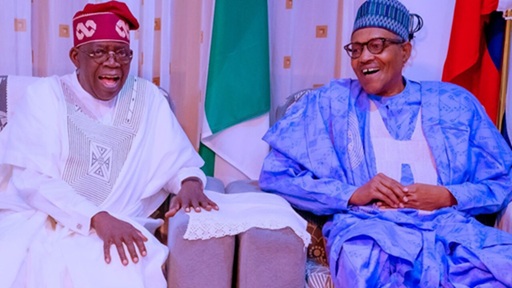
President Bola Ahmed Tinubu’s declaration that he “took over from myself” has resurfaced online, reigniting debate over the economic legacy of the administration of his predecessor, the late Muhammadu Buhari.
Tinubu made the controversial remark in April 2026 while receiving members of the Renewed Hope Ambassadors at the Presidential Villa in Abuja. Speaking about the state of the Nigerian economy when he assumed office in May 2023, the President said he did not need to look back because he considered the Buhari administration a continuation of the political partnership that brought the All Progressives Congress to power.
“I didn’t have to look back because the truth is, I took over from myself. The late Buhari was me; he was a partner. If I took over from him, is that not from myself?” Tinubu said.
The comment, originally made months ago, has now resurfaced amid renewed arguments over whether the current administration should continue to attribute Nigeria’s economic difficulties to problems inherited from the Buhari years.
Tinubu’s remarks have attracted particular attention because his administration has repeatedly defended its economic reforms as necessary responses to serious fiscal and structural challenges inherited in 2023.
Since assuming office, Tinubu has implemented major reforms, including the removal of petrol subsidies and changes to foreign-exchange policy. The government has argued that the measures were necessary to reduce pressure on public finances, attract investment and establish a more sustainable economic foundation.
The reforms, however, have also imposed significant costs on households, businesses and workers, particularly through higher transportation and living expenses.
Against this backdrop, the President’s statement has become a talking point among critics who argue that the government cannot simultaneously present Buhari’s administration as a political and policy partner while distancing itself from the economic consequences of that period.
Tinubu, however, did not present his statement as an admission that his administration should accept responsibility for every problem facing the country. Rather, his remarks appeared to emphasise continuity between the two administrations and his determination to focus on correcting existing problems instead of spending political capital on assigning blame.
“If something is wrong, fine. Live with it, correct it, move on,” the President said, urging his supporters to remain focused on the task of transforming the country.
The distinction is politically important.
Buhari governed Nigeria from 2015 until 2023, while Tinubu succeeded him on May 29, 2023. During the transition, the Tinubu administration inherited an economy facing substantial fiscal pressures, foreign-exchange shortages, high debt-service costs and declining oil production.
At the same time, Tinubu was not an outsider to the political structure that produced the Buhari government. He was one of the leading figures involved in the formation of the APC and was a major political force within the party throughout Buhari’s presidency.
That political history provides context for the President’s description of Buhari as his “partner.”
The resurfaced statement has therefore generated a broader question about political accountability: where does responsibility for Nigeria’s economic challenges begin and end when successive administrations belong to the same political party and political coalition?
For opposition politicians and critics of the government, the remark provides an opportunity to challenge what they describe as inconsistent narratives about the country’s economic inheritance.
Supporters of the administration, on the other hand, can interpret the statement as an acknowledgement of continuity rather than an attempt to rewrite history. They argue that Tinubu inherited a difficult situation but chose to accept responsibility for fixing it instead of remaining trapped in the politics of blame.
The controversy is likely to remain relevant as Nigeria approaches the 2027 general election.
Economic performance is expected to be one of the central issues in the campaign, with the ruling APC pointing to reforms, investment and fiscal changes, while opposition parties are likely to focus on inflation, living costs, unemployment, poverty and the impact of government policies on ordinary Nigerians.
Ultimately, Tinubu’s “I took over from myself” remark has transformed into more than a political soundbite. It has reopened the debate over the relationship between the Buhari and Tinubu administrations—and whether political continuity should also mean shared responsibility for both the successes and failures inherited from the past.
As the 2027 election approaches, Nigerians may increasingly ask not simply who created the problems, but who had the power to fix them, what has been fixed, and what remains unresolved.