

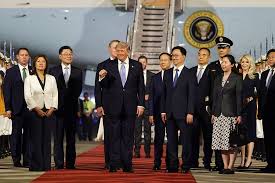
U.S. President Donald Trump arrived in Beijing on Wednesday evening for a major two-day summit with Chinese President Xi Jinping, as both global powers seek to address growing tensions over trade, artificial intelligence, Taiwan, and international security issues.
The visit marks the first official state trip to China by a sitting American president in nearly a decade and is being viewed as one of the most significant diplomatic engagements between Washington and Beijing in recent years.
Trump landed in the Chinese capital alongside a high-powered delegation of leading American business executives, highlighting the economic importance of the summit. Among those accompanying the president were Elon Musk, Jensen Huang of NVIDIA, Tim Cook of Apple, as well as executives from BlackRock, Blackstone, and Goldman Sachs.
The summit comes amid heightened competition between the United States and China over advanced technology, global economic influence, and regional security.
Chinese authorities welcomed the American delegation with official ceremonies and tight security across Beijing, where the two leaders are expected to hold several rounds of talks focused on economic cooperation and geopolitical concerns.
According to officials familiar with the agenda, Trump and Xi are scheduled to engage in private one-on-one meetings, attend formal diplomatic events, and participate in cultural activities, including a visit to the historic Temple of Heaven.
A state banquet hosted by the Chinese government is also expected to take place during the visit.
Focus on Trade and Market Access
Trade discussions are expected to dominate much of the summit as the Trump administration pushes for broader market access for American companies operating in China.
Washington is reportedly seeking agreements that would expand opportunities for U.S. firms in technology, manufacturing, and finance while easing long-running tariff disputes between the world’s two largest economies.
The participation of major technology and investment leaders reflects the administration’s effort to secure economic breakthroughs capable of improving investor confidence and strengthening commercial ties.
One of the most closely watched issues involves restrictions on advanced semiconductor exports and artificial intelligence technologies.
The United States has imposed limitations on the sale of certain high-end AI chips and semiconductor equipment to China over national security concerns. Beijing has criticised those restrictions, arguing that they unfairly target China’s technological development.
Global investors are now monitoring the Beijing summit for signs that both countries may soften positions on technology restrictions or tariff policies.
Business leaders are also paying close attention to reports of possible discussions involving renewed aircraft purchases from Boeing, which could provide a major boost to the U.S. aviation industry.
Taiwan and Global Security Issues
Beyond trade and business, geopolitical tensions are expected to remain central to the discussions.
Taiwan continues to represent one of the most sensitive areas in U.S.-China relations, with Beijing insisting the island remains part of Chinese territory while Washington maintains strategic support for Taipei.
Military activity in the Taiwan Strait and concerns about regional stability have increased pressure on both governments to manage tensions carefully.
Analysts believe both leaders are likely to emphasise stability and diplomatic engagement publicly, even as major disagreements remain unresolved behind closed doors.
The summit is also taking place amid broader international uncertainty, including ongoing tensions linked to the Iran conflict and concerns over shifting alliances in global politics.
Diplomatic observers suggest both countries may explore areas of cooperation on international security and economic stability despite their strategic rivalry.
Markets Await Outcome of Summit
Financial markets around the world are closely following developments from Beijing, with hopes that the summit could lead to reduced trade tensions and improved economic cooperation.
Experts say any progress on tariffs, technology restrictions, or supply chain issues could significantly affect global markets and international business confidence.
Technology firms, in particular, are awaiting updates on AI regulations and semiconductor trade policies that could influence the future of the global tech industry.
While some analysts remain cautious about the possibility of major breakthroughs, many believe the summit itself signals an important effort by both nations to reopen high-level dialogue after years of strained relations.
As talks continue in Beijing, global attention remains focused on whether Trump and Xi can find common ground on critical economic and geopolitical issues shaping the future of international relations.


