

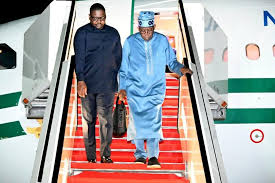
President Bola Ahmed Tinubu has returned to Nigeria after completing a two-week diplomatic and investment-focused tour across Europe and Africa, where he held meetings with global investors, business executives, and regional leaders aimed at strengthening economic partnerships and promoting Nigeria’s investment opportunities.
The president’s trip included engagements in France, Kenya, and Rwanda, where discussions centered on trade expansion, foreign investment, industrialisation, regional integration, and economic cooperation.
Government officials praised the tour as a strategic effort to attract international investors and deepen Nigeria’s economic relationships with global financial institutions and African partners.
However, critics questioned the relevance and timing of the foreign engagements, arguing that Nigeria continues to face severe domestic challenges including inflation, insecurity, unemployment, and rising living costs.
Tinubu arrived back in Abuja on Friday and was welcomed by government officials, party leaders, and supporters ahead of major political activities expected within the ruling All Progressives Congress (APC).
France Meetings Centered on Economic Partnerships
One of the major stops during the president’s trip was France, where Tinubu reportedly met executives from leading international financial institutions and investment firms.
Among the companies mentioned by officials were Citibank and Prudential, whose representatives discussed investment opportunities in sectors including finance, infrastructure, and economic development.
Government officials stated that the meetings were intended to strengthen investor confidence in Nigeria and encourage foreign capital inflows capable of supporting economic growth and job creation.
The administration has consistently emphasized international investment as a major part of its economic agenda, particularly as Nigeria seeks to diversify its economy and improve infrastructure.
Economic analysts note that African countries are increasingly competing for foreign investment amid ongoing global economic uncertainty.
Kenya Summit Highlights African Trade Cooperation
Tinubu also participated in the Africa Forward Summit in Kenya, where regional leaders and business stakeholders discussed economic integration and cooperation within Africa.
During the summit, the Nigerian president advocated stronger intra-African trade and encouraged deeper collaboration among African economies to reduce dependence on external markets.
He also spoke about opportunities within the “blue economy,” emphasizing the importance of maritime resources, fisheries, waterways, and coastal trade in driving economic growth across the continent.
According to officials, Tinubu encouraged African governments and investors to explore partnerships capable of unlocking greater economic potential from Africa’s maritime and coastal industries.
Experts say stronger regional trade remains one of the major goals of ongoing continental economic reforms.
Rwanda Forum Focuses on Industrialisation
Another major highlight of the tour was Tinubu’s appearance at the Africa CEO Forum in Kigali, Rwanda, one of the continent’s leading economic and investment gatherings.
At the event, the president called for faster implementation of the African Continental Free Trade Area (AfCFTA), which seeks to create a single African market for goods and services.
Tinubu argued that African nations must accelerate industrialisation and focus more heavily on value-added production instead of exporting raw materials.
He stressed that processing resources locally could help create jobs, improve manufacturing capacity, and strengthen African economies.
The president also encouraged African governments and private sector leaders to collaborate more effectively in building sustainable regional industries and supply chains.
Government Defends International Engagements
Presidential aides defended the foreign tour, describing the engagements as essential for promoting Nigeria’s economic interests internationally.
Officials claimed the meetings generated investment interest in key sectors including energy, infrastructure, manufacturing, technology, and finance.
Supporters of the administration argued that Tinubu’s participation in global economic forums helps strengthen Nigeria’s international image and improves investor confidence.
Some government allies also pointed to the importance of economic diplomacy in attracting long-term development partnerships and expanding trade opportunities.
Critics Raise Concerns Over Domestic Challenges
Despite official optimism, opposition voices and social media commentators criticized the president’s extended foreign engagements.
Critics argued that Nigeria continues to face urgent domestic issues requiring stronger leadership attention at home.
Among the concerns raised were inflation, rising food prices, insecurity, unemployment, and worsening economic hardship affecting millions of Nigerians.
Some opponents described the trip as excessive or disconnected from the daily struggles experienced by ordinary citizens.
Others argued that foreign investment alone cannot solve Nigeria’s economic problems without stronger domestic governance and institutional reforms.
Tinubu Returns Ahead of APC Activities
The president’s return comes as the APC prepares for major internal political activities and consultations ahead of future elections.
Tinubu is expected to oversee party primaries and strategic meetings beginning Saturday, with APC leaders emphasizing party unity and internal stability.
Political analysts believe the ruling party has already begun positioning itself ahead of the 2027 elections, particularly as opposition parties continue coalition talks and political realignments.
The president reportedly greeted supporters at the airport and urged APC members to remain united as political activities intensify.
Nigeria’s Economy Remains Key Political Issue
The investment tour comes amid continuing national debate about Nigeria’s economic direction under Tinubu’s administration.
Since taking office, the government has introduced major reforms including fuel subsidy removal and changes to the foreign exchange system.
Supporters say the policies are necessary for long-term economic recovery and fiscal stability.
Critics, however, argue that the reforms have increased hardship due to rising inflation, transportation costs, and food prices.
Political observers say economic performance and public perception of the government’s policies will remain central issues ahead of future elections.
Attention Turns to Economic Outcomes
With the president now back in the country, attention is expected to shift toward the practical outcomes of the investment meetings and diplomatic engagements held during the tour.
Supporters hope the trip will lead to increased foreign investment, stronger trade relationships, and economic growth opportunities for Nigeria.
Critics, however, say Nigerians will judge the success of the tour based on visible improvements in living conditions, employment opportunities, and economic stability.
As economic pressures continue across the country, expectations remain high regarding how international engagements will translate into measurable benefits for ordinary Nigerians.


