

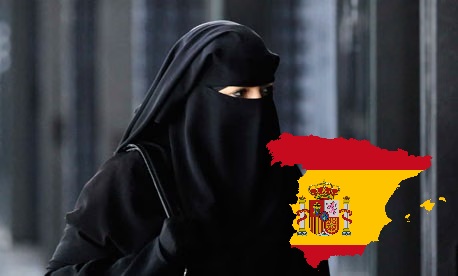
The Spanish city of Lleida has approved a new municipal ordinance prohibiting people from wearing clothing or other items that completely cover the face in most public spaces, a measure that will affect the use of the burqa and niqab.
The regulation was approved by the city parliament on Friday in a 16–11 vote. Although the ordinance does not specifically mention the burqa or niqab, its provision banning full-face coverings in public spaces is expected to apply directly to the Islamic garments.
Lleida, a city of about 150,000 people in northeastern Spain, previously introduced a restriction on full-face veils in some public spaces in 2010. However, Spain’s Supreme Court annulled that measure in 2013 following a legal challenge by a Muslim association.
The court ruled that the municipal government had exceeded its powers by restricting a fundamental right such as religious freedom. Similar measures adopted by other municipalities were also affected by subsequent legal challenges.
The latest ordinance was therefore formulated without explicitly naming Islamic clothing. Instead, it refers generally to clothing or items that “totally cover the face” while allowing several exceptions.
Under the new rules, exemptions apply in circumstances involving the exercise of fundamental rights, places of worship and certain customs or cultural celebrations where such clothing is socially accepted. Police are also required to issue a warning before a sanction is imposed.
People who violate the regulation can face fines. Reports from local media indicate that the lowest category of offence carries a fine ranging from €400 to €750, while more serious violations can attract higher penalties of up to €3,000.
The burqa and niqab are both full-face coverings, although they differ in design. A burqa covers the entire body and face, including a mesh section over the eyes, while a niqab covers the face while leaving the eyes visible.
Lleida’s decision comes despite Spain having no national law that generally prohibits the wearing of burqas or niqabs in public spaces.
In February 2026, Spain’s Congress rejected a proposal by the right-wing Vox party seeking national restrictions on the use of the garments. The proposal was defeated by 177 votes to 170.
Spain’s approach therefore remains different from that of several other European countries that have introduced national restrictions on full-face coverings.
France and Belgium have nationwide restrictions, while Switzerland, Denmark and Bulgaria also have laws restricting full-face coverings in public spaces. Other European countries have more limited restrictions applying to specific settings such as schools, hospitals or public services.
The Lleida ordinance was supported by an unusual combination of political parties. According to the city authorities, the governing Catalan Socialist Party secured support from Junts and the right-wing Vox party to pass the measure.
Lleida Mayor Félix Larrosa defended the ordinance as a measure connected to public coexistence and compliance with municipal rules.
“Living together means respecting one another, and respecting one another also means following the rules,” Larrosa told the municipal parliament.
The decision could nevertheless face legal scrutiny because of the city’s previous experience with the courts. The Supreme Court’s 2013 ruling established an important legal precedent concerning the ability of local authorities to restrict religious dress.
The new wording is intended to avoid directly targeting a particular religious garment, but its practical impact on Muslim women who wear the burqa or niqab means that questions about religious freedom and municipal powers are likely to remain part of the debate.
For now, the measure applies to Lleida rather than Spain as a whole. It does not amount to a nationwide Spanish ban on the burqa or niqab, and the country’s national legal position remains that there is no general prohibition on the garments in public spaces.


