

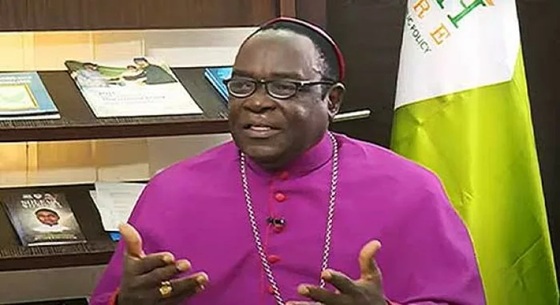
The Catholic Bishop of Sokoto Diocese, Matthew Hassan Kukah, has expressed concern over what he described as the declining influence of Catholic values in Nigeria, urging members of the Church to renew their commitment to the principles that historically shaped its contribution to society.
Kukah made the remarks on Friday at St. Finbarr’s College Auditorium, Akoka, Lagos, while delivering a lecture titled, “To Conquer or to Serve? Thoughts on the Contributions of the Catholic Church to Human Development and the Making of a Good Society in Nigeria.”
The lecture was organised in memory of the late Rev. Fr. Denis Slattery, whom Kukah described as one of the significant missionaries associated with the Irish missionary enterprise in Nigeria.
Reflecting on the concept of “soft power”, developed by American political scientist Joseph Nye, Kukah said lasting influence was more effectively achieved through service, attraction and the transformation of people’s lives than through coercion.
He said the approach was evident in the missionary work that led to the establishment of schools, hospitals and other institutions across Nigeria.
According to the bishop, however, the central question for contemporary Catholics was whether the values acquired through those institutions continued to influence their conduct at home, in their professions and in public life.
Kukah expressed concern that some Catholics appeared to devote greater time, resources and energy to social, political, ethnic and other associations than to their parishes and the Church.
He argued that repeated investment of time, relationships and resources in particular organisations could gradually shape people’s priorities and influence their decisions.
The bishop also warned that the failure to transmit Catholic values to younger generations could contribute to further erosion of those values.
He said the Church needed to look beyond preserving its physical institutions and focus on ensuring that the principles associated with Catholic education and spiritual formation continued to influence Nigerian society.
Missionary contribution
Kukah also highlighted the historical contribution of Catholic missionaries to education and healthcare in Nigeria.
He said missionaries regarded their work as extending beyond religious conversion to improving people’s quality of life, particularly through education and healthcare.
According to him, missionaries considered education a foundation for a good life and therefore established schools alongside healthcare facilities, including in remote communities.
Kukah cited Catholic Church statistics indicating that the Church operates more than 231,000 schools and universities across 171 countries, educating approximately 72 million students.
He added that the Catholic Church operates about 5,100 nursery, primary and secondary schools in Nigeria, excluding its universities and other tertiary institutions.
The bishop listed several Catholic missionary schools that played significant roles in the education of generations of Nigerians, including Christ the King College, Onitsha; Queen of the Rosary College, Onitsha; Holy Rosary College, Enugu; St. John’s College, Jos; St. Louis College, Jos; St. Louis College, Kano; and St. John’s College, Kaduna.
He urged former students of such institutions to reflect on the extent to which the discipline, education and moral formation they received had influenced their subsequent contributions to society.
Kukah recalled the strict discipline traditionally associated with Catholic schools and the roles played by priests, religious sisters, teachers and principals in mentoring students.
He argued that preserving the legacy of Catholic education should involve more than maintaining schools, hospitals and other institutions.
Rather, he said, the values associated with those institutions should continue to influence people’s conduct in their homes, workplaces, politics and wider public responsibilities.
His comments come shortly after the Catholic Bishops Conference of Nigeria called on governments to address insecurity, poverty and other challenges affecting Nigerians.
In a communique issued after its September 2026 plenary, the bishops called for stronger action against banditry, kidnapping and displacement and urged authorities to create conditions that would enable internally displaced persons to return to their ancestral communities.
The bishops also called for measures to reduce the financial burden on poor Nigerians, improve infrastructure and strengthen accountability ahead of the 2027 general elections.
Kukah’s latest intervention similarly focused on the relationship between institutional influence and the values demonstrated by individuals who pass through religious and educational institutions.
He challenged the Catholic community to consider whether its long-standing institutions were still producing the kind of moral and social influence envisioned by their founders.
For Kukah, renewing that influence would require Catholics to reconnect their faith, education and public responsibilities, ensuring that the principles associated with the Church’s missionary heritage remain visible in Nigerian society.


