

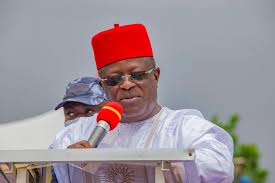
A political storm has erupted in Nigeria following comments by the Minister of Works, David Umahi, who linked ongoing federal infrastructure projects in the South-East to expected political support for President Bola Ahmed Tinubu ahead of the 2027 general elections.
The minister made the remarks while inspecting major federal road construction projects across the South-East geopolitical zone, where he reviewed progress on several key highways and infrastructure developments funded by the federal government.
Among the most prominent projects is a 123-kilometre superhighway valued at approximately ₦454 billion, with the federal government reportedly releasing about 50 percent of the required funding so far.
While highlighting progress on these projects, Umahi called for what he described as strong political backing from communities benefiting from federal investments, a statement that has since triggered widespread debate across political and civic circles.
Inspection Tour Highlights Major Federal Road Investments
During his tour, the Works Minister visited multiple infrastructure sites aimed at improving transportation networks and economic integration in the South-East. He emphasized that the current administration has significantly scaled up road development efforts in the region since 2023.
Key projects referenced during the inspection include:
- Ongoing rehabilitation of the Enugu–Onitsha Expressway
- Construction of new highway corridors connecting commercial hubs
- Expansion and modernization of federal road infrastructure
- Transport link improvements supporting regional trade
Umahi noted that these projects are intended to improve mobility, reduce logistics costs, and strengthen economic activity across the region.
He further argued that the South-East has witnessed increased federal attention under the current administration compared to previous years, particularly in infrastructure development.
Political Statement Sparks Heated Reactions
However, the minister’s remarks linking infrastructure delivery to political support have generated controversy, with critics accusing him of blurring the line between governance and electoral campaigning.
Opposition figures and civic groups argue that public infrastructure projects are financed by taxpayers and should not be presented as contingent on voting behavior or political loyalty.
They expressed concern that such statements could undermine public trust in government institutions, especially as Nigeria gradually moves closer to the 2027 election cycle.
Some critics also warned that linking development projects to electoral expectations risks politicizing essential public services and deepening regional political tensions.
Supporters Say Remarks Reflect Political Reality
In contrast, supporters of the minister have defended his comments, describing them as a realistic reflection of Nigeria’s political environment, where electoral outcomes often influence policy continuity and project prioritization.
They argue that political alignment can play a role in ensuring sustained funding and completion of large-scale infrastructure projects, especially in a highly competitive democratic system.
Supporters further maintain that the current administration has made visible efforts to improve infrastructure delivery across multiple regions, including historically underserved areas.
Tinubu Administration’s Infrastructure Drive in Context
Since assuming office in 2023, President Bola Ahmed Tinubu has prioritized infrastructure development as part of broader economic reforms. The administration has focused heavily on road rehabilitation, transportation expansion, and regional connectivity projects.
In the South-East, several federal projects have been initiated or accelerated, including major expressway rehabilitations and transport infrastructure upgrades aimed at boosting economic integration.
Government officials have consistently maintained that these investments are part of a nationwide development strategy designed to address infrastructure deficits and support long-term economic growth.
Rising Political Tensions Ahead of 2027 Elections
The controversy reflects growing political sensitivity as Nigeria prepares for the 2027 general elections. Political actors are increasingly engaging in early mobilization efforts, particularly in regions considered electorally strategic.
The South-East, which recorded strong opposition support in the 2023 elections, is expected to remain a key battleground in the upcoming electoral cycle.
Analysts believe that infrastructure development, governance performance, and regional political alliances will significantly shape voter behavior in 2027.
Debate Over Governance and Political Messaging
The incident has also reignited a broader national debate about the boundary between governance communication and political campaigning.
While it is common for government officials to highlight achievements, critics argue that explicitly linking public projects to electoral outcomes risks undermining democratic norms and accountability.
Civil society observers have called for clearer separation between official government duties and partisan political messaging, especially among cabinet members responsible for public resources.
At the same time, some analysts note that early political messaging is becoming increasingly common in Nigeria’s evolving political environment.
Infrastructure Delivery and Public Expectations
Beyond the political debate, the ongoing infrastructure projects remain critical to economic development in the South-East. Roads such as the rehabilitation of the Enugu–Onitsha Expressway are seen as vital for improving trade, reducing travel time, and supporting industrial activity in the region.
However, concerns remain that politicizing such projects could affect public perception of fairness in government resource allocation.
Citizens and stakeholders continue to call for consistent, transparent, and equitable infrastructure development regardless of political affiliation.


