

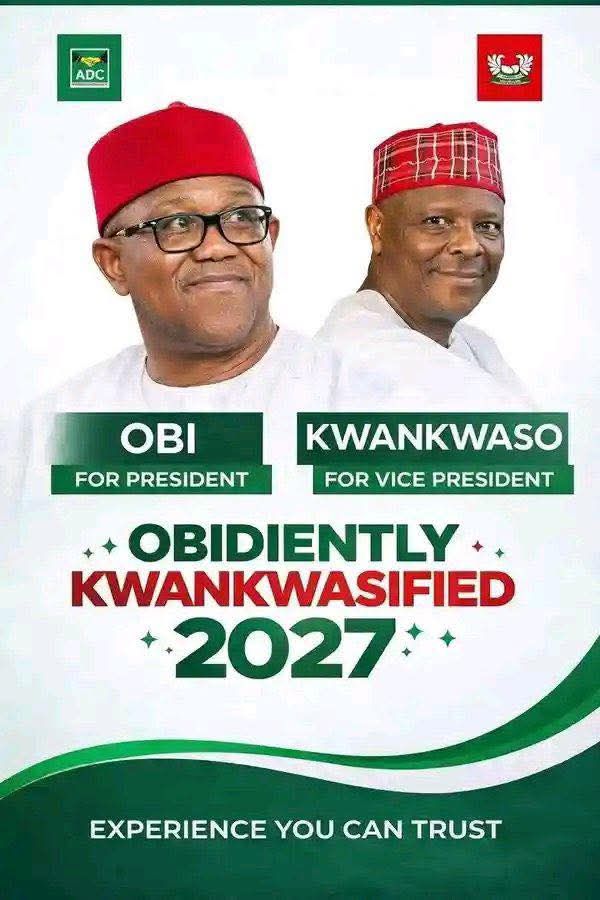
Fresh political intrigue has gripped Nigeria’s evolving electoral landscape following the circulation of campaign-style posters promoting a possible 2027 presidential ticket pairing Peter Obi and Rabiu Kwankwaso under the platform of the African Democratic Congress (ADC).
The posters, which have gained traction across social media and political circles, project a joint candidacy that many supporters describe as a strategic fusion of influence across Nigeria’s regional and demographic divides. Obi, a former governor of Anambra State, is widely associated with a strong youth-driven support base in the South, while Kwankwaso, former governor of Kano State, commands significant grassroots loyalty in the North, particularly through his longstanding political movement.
Proponents of the rumored alliance argue that such a ticket could represent a formidable political force capable of reshaping the 2027 contest. Among those lending public enthusiasm is Bashir El-Rufai, who described the potential pairing as a “game-changer,” suggesting it could disrupt traditional voting patterns and bridge longstanding regional divides.
However, not all reactions have been optimistic. Political analysts and skeptics caution that while the combination appears strong on paper, it could face resistance rooted in regional sensitivities, party cohesion challenges, and ideological differences. Concerns have also been raised about how such an alliance would be received within broader political structures and among competing blocs.
Notably, neither Obi nor Kwankwaso has issued any formal statement confirming or denying the speculation. Similarly, the ADC has remained silent on the matter, even as it continues to navigate internal organizational challenges ahead of what is expected to be a highly competitive election cycle in February 2027.
The emergence of these posters highlights the growing momentum of early political alignments in Nigeria, where coalition-building and strategic partnerships are increasingly seen as critical to electoral success. Whether the Obi–Kwankwaso ticket materializes or remains speculative, the conversation it has sparked underscores a shifting political dynamic—one in which voter expectations, regional balance, and youth engagement may play decisive roles.
As the political atmosphere gradually intensifies, Nigerians will be watching closely for clarity from the key figures involved and for signals that may confirm whether this widely discussed alliance is a calculated move or simply another ripple in the country’s ever-active political arena.


