

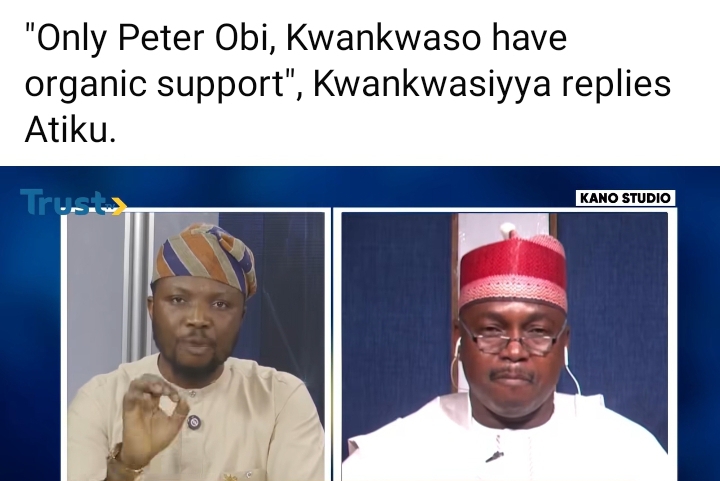
A chieftain of the Kwankwasiyya movement, Hon. Mai-Lemo, has asserted that only Peter Obi and Rabiu Musa Kwankwaso enjoy genuine grassroots backing across Nigeria.
Speaking during a live programme on Trust TV, Mai-Lemo dismissed claims of widespread northern support for Atiku Abubakar, insisting that the political structures surrounding Obi and Kwankwaso are driven by “organic” followership rather than elite arrangements.
He argued that both leaders have built loyal bases over time, particularly among young voters and reform-minded Nigerians, contrasting this with what he described as “top-down political mobilization” associated with traditional power blocs.
The remark comes amid intensifying permutations ahead of the 2027 general elections, as key actors continue to test their popularity and consolidate influence across regions.
Hon. Mai-Lemo’s statement on Trust TV reflects a growing political narrative within the Kwankwasiyya camp as Nigeria edges closer to the 2027 elections: a contest not just of party structures, but of perceived grassroots legitimacy.
By saying “only Peter Obi and Kwankwaso have organic support,” the argument being pushed is that their popularity is not primarily dependent on state machinery, political godfathers, or elite coalitions, but on sustained personal followership that cuts across demographics—especially youths, urban voters, and first-time political participants.
For Peter Obi, supporters often point to the 2023 election cycle, where his campaign under the Labour Party generated massive digital engagement, street-level mobilization, and diaspora enthusiasm, despite limited traditional party structure in many states. His appeal is frequently described as issue-driven—focusing on governance, accountability, and economic reform—which resonates strongly with younger voters and the urban middle class.
For Rabiu Musa Kwankwaso, the “organic support” claim is rooted in the Kwankwasiyya movement itself, which has evolved over decades into a structured political ideology within Kano and beyond. The movement is known for its distinct branding (red caps), disciplined grassroots organisation, and loyalty network that has repeatedly proven effective in Kano politics and parts of northern Nigeria. Supporters argue that Kwankwaso’s base is not merely electoral but ideological and generational, cultivated through education-focused policies and populist outreach.
The political subtext of Mai-Lemo’s remark is also a subtle pushback against claims often associated with established national figures like Atiku Abubakar, whose support base is widely seen as reliant on long-standing party structures, elite alliances, and negotiated political coalitions across regions. While Atiku remains one of Nigeria’s most experienced national politicians, critics within rival camps often question whether his support is “organic” or “constructed through political consensus-building.”
However, in practical political terms, the distinction between “organic” and “structured” support is not always clear-cut in Nigerian elections. Winning a national election typically requires both: grassroots enthusiasm and elite-level coalition building. Even candidates with strong street-level popularity still need party machinery, electoral agents, funding networks, and regional alliances to translate popularity into votes.
So, Mai-Lemo’s comment is less a neutral assessment and more a political positioning statement—meant to elevate the credibility of Obi and Kwankwaso’s bases while indirectly challenging the electoral dominance narrative of older political blocs.
As 2027 approaches, this debate will likely intensify, especially as all three figures continue to test their influence across Nigeria’s increasingly fragmented political landscape.


