

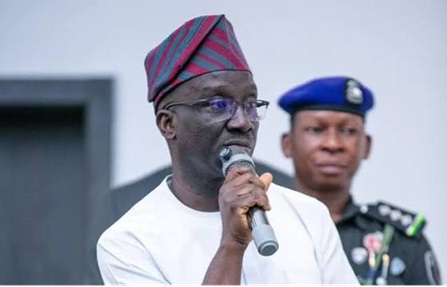
Edo State Governor Monday Okpebholo has defended the Federal Government’s economic reforms, saying Nigerians currently pay less for petrol than motorists in the United Kingdom.
Okpebholo made the comparison on Thursday while speaking at the “Operation Rescue Benin-Asaba Road” event in Edo State, where he expressed support for efforts to rehabilitate the deteriorating highway linking Edo and Delta states.
The governor said he travelled to London the previous week and used the opportunity to compare petrol prices in the United Kingdom with those in Nigeria.
According to him, after converting the British price into naira, a litre of petrol costs more than N3,000 in the UK.
He consequently argued that Nigerians were “doing very well” with the prevailing domestic price.
The comparison comes amid renewed concerns over the rising cost of petrol in Nigeria, where prices have increased sharply in recent weeks following a rise in international crude oil prices.
“I told my friend, ‘Let’s go and buy fuel just to know the cost of fuel between Nigeria and England.’ Let me tell you, after conversion, it’s about N3,000-something for one litre of fuel,” Okpebholo said.
Recent reporting provides some context for the comparison. Reuters reported on September 21 that petrol was selling for around N1,400 per litre in Lagos and Abuja, while some filling stations in northern Nigeria were charging as much as N1,500 per litre. Diesel prices had risen above N2,000 per litre.
In the UK, petrol prices have also risen significantly. MoneyWeek, citing RAC data, reported that the average petrol price stood at about 172 pence per litre on September 21, equivalent to roughly £1.72. It said the figure represented a four-year high amid disruptions to global oil markets.
Okpebholo said the difference in prices demonstrated what he regarded as the relative affordability of petrol in Nigeria, while acknowledging that Nigerians had been complaining about the cost of fuel and other essential commodities.
He attributed the current economic situation to ongoing reforms by President Bola Tinubu’s administration, describing the changes as difficult but necessary.
The governor likened the reforms to an aircraft taking off, arguing that passengers would have to wait until the aircraft reached cruising altitude before normal services could resume.
He expressed confidence that Nigeria would soon reach what he described as a “cruising level” under the reforms.
The governor also cited ongoing road construction projects as evidence of development under the Federal Government.
His comments came against the backdrop of the continuing debate over the removal of petrol subsidies and its effects on household incomes, transportation and businesses.
The subsidy removal in 2023 led to a major increase in petrol prices, while subsequent fluctuations in international crude prices and the exchange rate have continued to influence domestic fuel costs.
The Dangote refinery, which is operating at about 700,000 barrels per day, has also adjusted its wholesale petrol price in response to higher crude costs, according to Reuters. The development illustrates that domestic refining does not completely insulate Nigerian fuel prices from movements in the international oil market.
Meanwhile, Okpebholo used the Benin-Asaba Road event to express support for President Tinubu’s continued administration, saying those seeking to challenge him in the 2027 presidential election should reconsider their plans.
He also praised the President’s economic policies and said Edo State and Nigeria were moving in the right direction.
The governor’s comments come as the rising cost of petrol remains a major issue for Nigerian households, transport operators and businesses, with labour organisations and opposition politicians continuing to call for measures to cushion the effect of higher energy costs.
While Okpebholo’s UK-Nigeria comparison highlights the difference in nominal pump prices, petrol affordability also depends on factors such as income levels, transportation costs, taxation, household expenditure and purchasing power. The governor’s broader assessment of the economic reforms remains his political and economic position.


