
Former presidential candidate, Peter Obi, has declared that Nigeria is facing a dangerous democratic and economic crisis, warning that the country is steadily drifting towards national decline due to poor leadership, insecurity, corruption, and the weakening of democratic institutions.
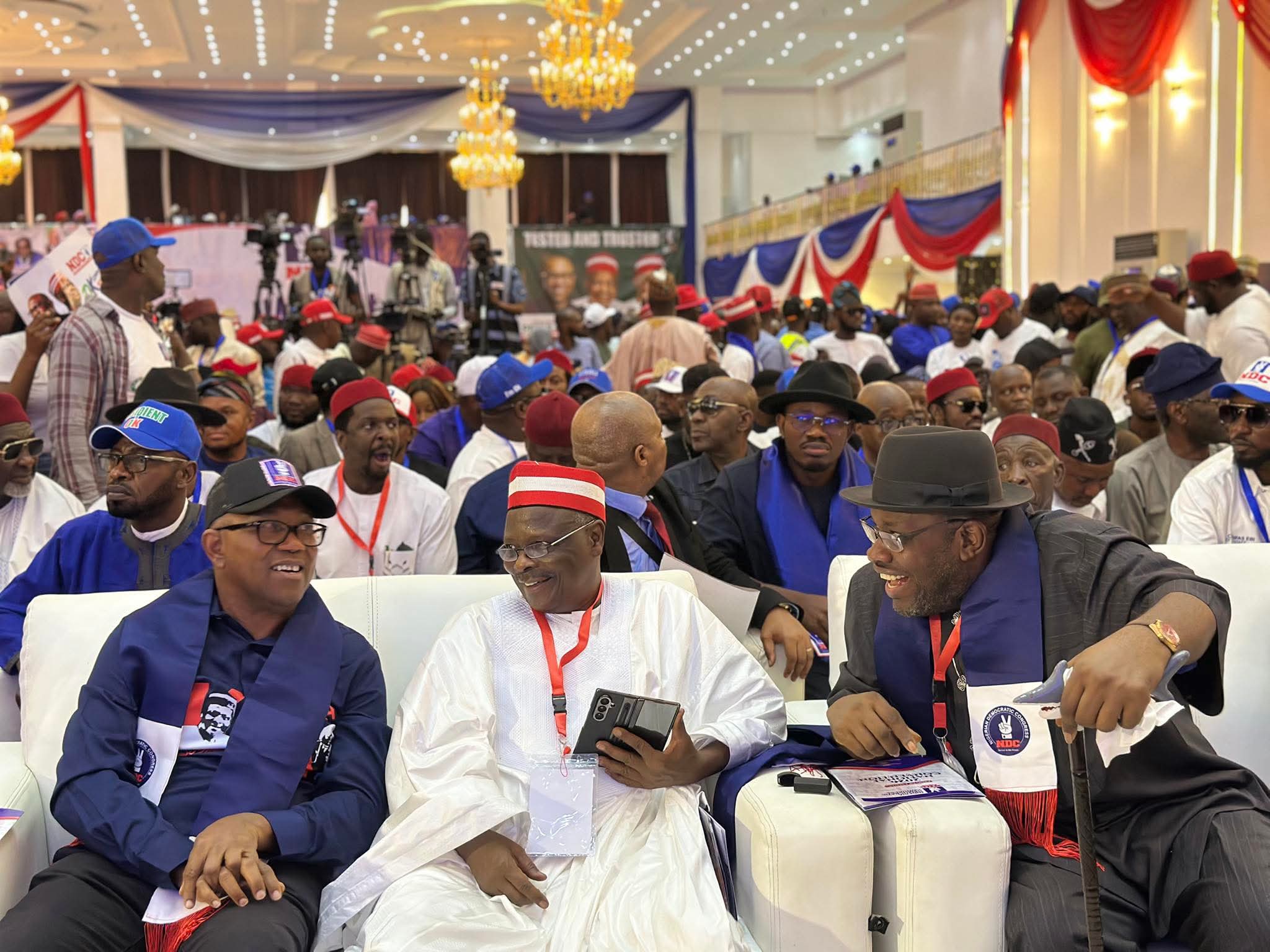
Obi made the remarks on Friday during the 1st convention of the Nigeria Democratic Congress held in Abuja, where he officially participated as part of the emerging coalition platform.
Quoting former British Prime Minister, Winston Churchill, Obi stated: “Some men change their party for the sake of their principles; others change their principles for the sake of their party.”
He described the convention as successful and reflective of “the resilience of Nigerians to change,” while expressing appreciation to the NDC leadership led by Henry Seriake Dickson for accommodating members of the coalition at what he termed “a critical moment in our national journey.”
The former Anambra State governor also extended gratitude to the African Democratic Congress and its interim leadership under David Mark for providing what he called “a democratic platform” following the legal crises that affected both the Labour Party and the New Nigeria People’s Party.
According to Obi, Nigeria’s democratic space is under severe threat as individuals who once defended justice and democratic values have now become defenders of electoral manipulation, coercion, intimidation, and political suppression.
“Those who once fought for justice now openly celebrate electoral injustice. What we are witnessing is not politics; it is a systematic assault on democracy and the will of the people,” he said.
Obi lamented the worsening socio-economic realities confronting Nigerians, noting that over 140 million citizens are trapped in multidimensional poverty while millions of youths remain unemployed or underemployed.
He further decried rising inflation, business failures, worsening insecurity, kidnappings, and the inability of farmers to safely access their farmlands, stressing that hundreds of Nigerians have been killed or displaced by insecurity in recent weeks.
“The most heartbreaking question confronting us is this: who consoles the grieving mother whose child was abducted on the way to school? Who speaks for the father who can no longer feed his family despite working every day?” he asked.
The former presidential candidate blamed Nigeria’s crisis on years of “deliberate sabotage” by a political class that prioritises personal interests above national development.
“Nigeria is not a poor country; rather, we are being looted into poverty,” Obi declared.
He called on Nigerians to rise above ethnic, religious, and political divisions to rebuild the country on the foundations of justice, equity, competence, and productivity.
Obi advocated deliberate investment in agriculture and manufacturing, especially the agricultural potential of Northern Nigeria, as part of efforts to transform Nigeria from a consumption-driven economy into a productive one.
He maintained that with “competent, compassionate and transformative leadership,” Nigeria can overcome insecurity, corruption, unemployment, inflation, and poor governance.
“I remain convinced that a new Nigeria is possible — a Nigeria that is united, secure, productive, inclusive, and governed by justice and fairness,” Obi concluded.
Obi raises alarm over Nigeria’s democracy, poverty at NDC convention in Abuja

- Advertisement -

