

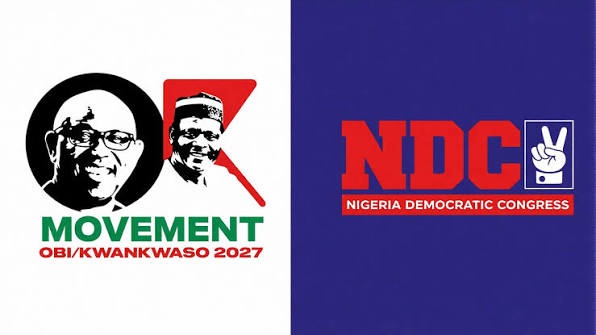
State chairmen of the Nigeria Democratic Congress have rejected the creation of parallel campaign structures by the Obi-Kwankwaso Movement ahead of the 2027 general elections, insisting that the party remains the recognised political structure through which its candidates will contest the election.
The position followed growing disagreements between the NDC and the support movement, popularly known as the OK Movement, over the organisation of campaign activities for the party’s presidential candidate, Peter Obi, and his running mate, Rabiu Kwankwaso.
Speaking to Sunday PUNCH across 10 states, several NDC chairmen said support groups associated with Obi and Kwankwaso could mobilise supporters but should not establish structures that compete with or operate independently of the party.
The dispute intensified after the OK Movement announced a 59-member Presidential Campaign Council for Obi and Kwankwaso. The NDC subsequently disowned the structure, saying it had not been authorised by the party’s National Working Committee.
The party maintained that only its leadership had the authority to constitute and announce an official presidential campaign council.
NDC National Leader, Senator Seriake Dickson, had also warned support groups against operating as parallel political structures. He said such groups should complement the party rather than compete with its formal organs or attempt to perform the functions of the party’s campaign machinery.
Some state chairmen have now echoed that position.
In Ogun State, NDC Chairman Femi Alao said the party was supreme and that no support movement could conduct a campaign without its approval.
Alao said the party had established mechanisms to accommodate different interest groups and urged supporters of the various movements to work together rather than create competing structures.
Similarly, Kano State NDC Chairman Hussaini Meriga said the OK Movement was operating under the party and must comply with its rules and regulations.
He noted that Obi and Kwankwaso had operated separate political movements before coming together on the NDC platform, but maintained that the movements were now support structures for candidates contesting under the party.
The situation is also being discussed in Anambra State, where NDC Chairman David Chukwudifu alleged that the Obidient Movement had sidelined him and the party’s 326 ward chairmen.
Chukwudifu said the state chapter was waiting for intervention from the party’s national leadership to address the disagreement. He also claimed that Obi had not responded to his calls seeking his intervention.
However, the situation is not uniform across the states.
The NDC chairman in Enugu State said the party and the Obidient Movement were working harmoniously, while the Akwa Ibom State chairman, Dr Willie Bassey, similarly said there was no disagreement between his state chapter and the Obi-Kwankwaso Movement.
The National Convener of the OK Movement, Jackie Wayas, also rejected the allegations that the movement was operating independently of the party.
The disagreement has nevertheless continued at the national level. The OK Movement’s Director-General, John Ughulu, previously rejected the NDC’s demand that its campaign structure be dissolved or surrendered to the party. The movement has maintained that it has its own leadership and organisational framework.
The dispute centres largely on the distinction between a political party and support organisations mobilising voters for its candidates. While the NDC leadership insists that formal campaign structures must remain under party authority, the OK Movement has argued that its organisational structure can operate independently while supporting the party’s presidential ticket.
The disagreement comes as political parties begin intensifying grassroots mobilisation ahead of the 2027 elections. How the NDC and the Obi-Kwankwaso Movement resolve their differences could determine how campaign responsibilities, grassroots mobilisation and election-day operations are coordinated across the states.
For now, positions remain divided. Some NDC state chairmen are demanding strict adherence to party structures, while other state chapters report cooperation with the support movements. The OK Movement, meanwhile, continues to maintain its separate organisational identity while backing the Obi-Kwankwaso ticket.


