

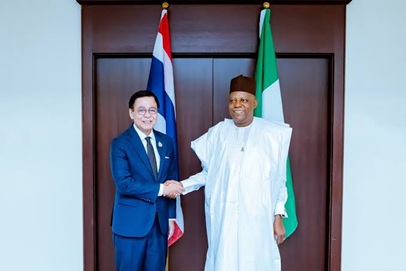
The Lagos State Government and Thailand have expressed renewed commitment to strengthening economic relations through increased investment, technology transfer and joint ventures across several strategic sectors.
The commitment was made at the Thailand-Nigeria Business Forum in Lagos, where government officials and business leaders explored opportunities for deeper commercial cooperation between Lagos and Thai companies.
Lagos State Governor, Babajide Sanwo-Olu, represented at the forum by the Commissioner for Commerce, Cooperatives, Trade and Investment, Folashade Ambrose-Medebem, said the existing annual trade volume between Nigeria and Thailand, estimated at slightly above $200 million, remained modest compared with the potential of both economies.
Sanwo-Olu said Lagos was ready to welcome Thai investment into sectors including agriculture, agro-processing, manufacturing, automotive components, electronics, consumer goods, logistics, digital technology, healthcare, hospitality and tourism.
He said the objective should extend beyond simply increasing the volume of goods exchanged between Nigeria and Thailand.
According to the governor, greater emphasis should be placed on Thai investments in Nigeria, Nigerian businesses gaining access to Thai technology and expertise, and the establishment of joint ventures capable of producing goods for both the Nigerian and wider African markets.
Such partnerships, he said, could strengthen local supply chains, facilitate technology transfer, improve skills and create quality employment opportunities for Lagos residents.
The governor described Lagos as Nigeria’s commercial nerve centre, a major financial and technology hub and a gateway to one of Africa’s largest consumer markets.
He urged Thai investors to explore opportunities in the state, identify credible Nigerian partners and familiarise themselves with the local regulatory environment before committing capital.
The Thai delegation, led by Deputy Prime Minister and Minister of Foreign Affairs Sihasak Phuangketkeow, also expressed interest in establishing stronger economic partnerships with Nigeria.
Phuangketkeow said Thailand was not merely interested in exploring business opportunities but wanted to build lasting partnerships with Nigerian businesses and institutions.
He identified business networking, tourism and agriculture among areas with significant potential for cooperation.
Tourism was highlighted as another avenue for strengthening relations, including medical and wellness tourism, agro-tourism, culinary tourism, cultural and heritage tourism, and business tourism.
The Thai official argued that stronger people-to-people connections could help create the trust and familiarity required for sustainable economic partnerships.
Thailand’s experience in agriculture and skills development was also identified as an area that could complement Nigeria’s efforts to expand commercial agriculture and increase local value addition.
The forum comes amid broader moves by Nigeria and Thailand to review and deepen their bilateral relationship.
Vice-President Kashim Shettima recently called for Nigeria’s relationship with Thailand to move beyond traditional areas such as crude oil and rice, identifying agriculture, information and communication technology, renewable energy and solid minerals as sectors with significant investment potential.
Nigeria and Thailand have also signed a Memorandum of Understanding on technical cooperation, signalling efforts to broaden bilateral collaboration in skills development, agriculture, technology and other areas.
For Lagos, the renewed engagement could provide an opportunity to attract more foreign capital while gaining access to technologies and expertise that could strengthen local industries.
Thailand, on the other hand, could gain access to Nigeria’s large consumer market and Lagos’s position as a commercial gateway to West Africa.
The Lagos Chamber of Commerce and Industry also welcomed the proposed collaboration, with its President and Chairman, Leye Kupoluyi, urging Thai manufacturers to consider local production and regional servicing opportunities.
He noted that Thailand’s experience in commercial agriculture and food processing could complement Nigeria’s agricultural development ambitions.
The forum also featured presentations from the Export-Import Bank of Thailand and other institutions on mechanisms for facilitating trade, investment and business partnerships.
The bank presented financial solutions including trade finance, export credit insurance and investment advisory services designed to reduce risks associated with cross-border transactions.
For Lagos, the challenge now will be converting diplomatic and business discussions into actual investments, factories, technology partnerships and jobs.
A sustained relationship between Lagos and Thailand could deliver significant benefits if both sides move beyond conferences and agreements towards concrete commercial projects.
The latest engagement therefore marks a potentially important step in Lagos’s efforts to attract international investment and diversify its economic partnerships.
For Thailand, Lagos offers access to one of Africa’s largest markets. For Lagos, Thailand offers capital, technology, manufacturing expertise and access to new commercial networks.
The success of the partnership will ultimately depend on how effectively both sides transform those complementary strengths into businesses that create value, transfer knowledge and generate employment.
With officials on both sides signalling that the relationship should be more than a one-day engagement, the next phase will be measured not by the number of meetings held, but by the investments, partnerships and jobs that emerge from them.